“I live for the slower seasons”:
Kerry Docherty on her career as a writer and cofounder
October 7, 2026
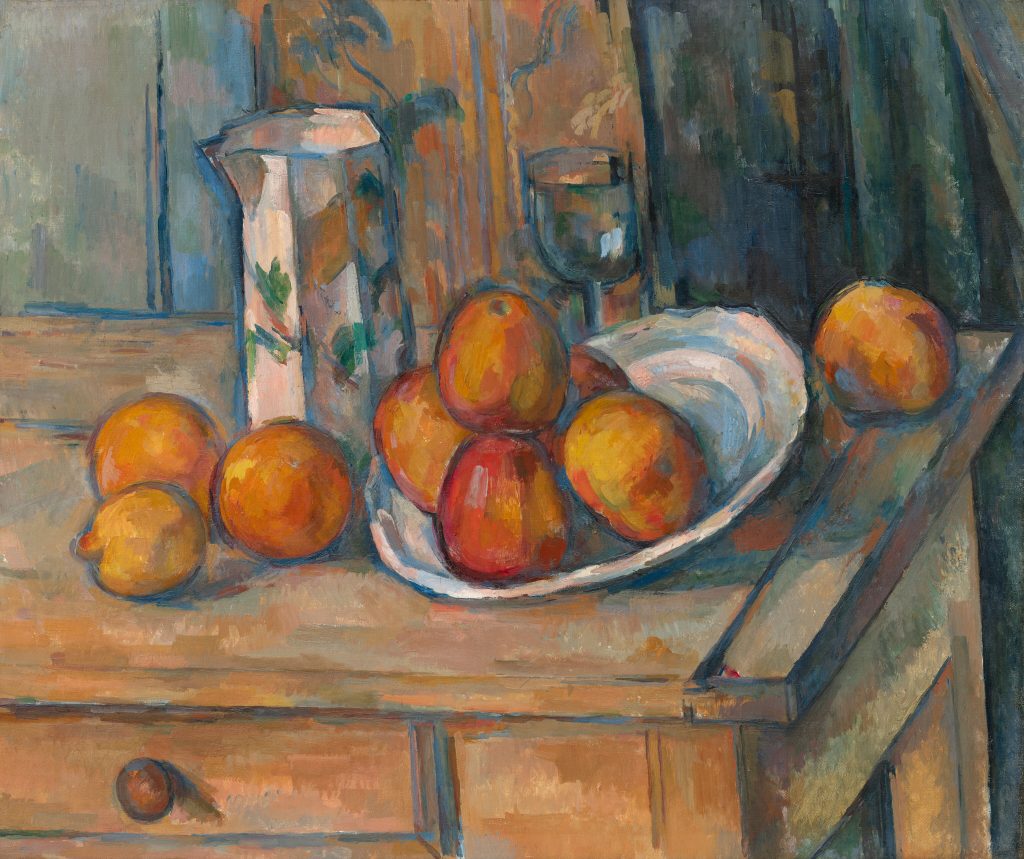
Paul Cézanne, “Still life with milk jug and fruit” (c. 1900)
In her memoir Selfish, Kerry brings readers through a deeply honest journey of unlearning as she examines some of the long-ingrained beliefs and behaviours that shaped her identity. “Somewhere along the line I decided to be the [one] who was always fine,” she writes. “I wouldn’t burden anyone with my needs or wants. I’d be better than fine: I would be successful! Happy! Helpful! Need-free! Selfless!”
It’s a role that will only be too familiar to all of the women who have been socialized to prioritize the needs of others above their own. I was grateful to have learned more about her process through our exchange.
Jana M. Perkins, PhD
Host, Women of Letters
Kerry Docherty cofounded the lifestyle clothing brand Faherty with her husband and his identical twin. She is passionate about using creativity and community to cultivate joy. Kerry is also the author of the children’s book Somewhere, Right Now, featuring art by New York Times bestselling illustrator Suzie Mason. She lives with her husband and two children on the New Jersey shore, where she is constantly looking for sea glass.

What’s the first thing you remember being good at?
Kerry Docherty: I remember being very good at rhyming, ha. I loved writing and poetry as a child, and I had a rhyming dictionary I would use often when working on simple poems for my family and friends.

Fast-forward to today. How did the path to what you’re doing now unfold?
Kerry Docherty: I always dreamed of writing a book one day, but I don’t think I envisioned it being a career.
I have spent the last 13 years focused on our clothing company, Faherty Brand, and it’s been such a gift to have also carved out time to write my memoir, Selfish, which just came out this past April. For the first time, really, I’m allowing myself to put on the identity-cloak of a writer and it feels wonderful, scary, and strange.
Tell us about some of the projects, ideas, or questions you’re currently working on.
Kerry Docherty: I’m now working on a novel and trying to edit my book of poetry. My poetry book is always present, but rarely tended to, and so it feels a bit unruly and full of weeds at this point in time.
I love planting the seeds of prose, but weeding the poems? Figuring out what words don’t resonate anymore? Trying to find better metaphors? Less cliches? It feels too much for me right now. The act of writing a novel, however, feels brimming with opportunity. I have never “world built” before; never invented characters and talked to them as if they were real people, wondering what do you like to eat? What happened to your mother? What do you fantasize about? What are you not saying? Coming up with storylines and plot twists has been an addictive journey: a true choose-your-own-adventure.
Questions I’m asking myself: I no longer am focused on the question of, “Can I do it?” (spoiler alert, women, we can do it!). Rather, “But do I want to?”
How do you get your work in each day? What does that process look like, and what are the conditions that help you perform at your best?
Kerry Docherty: My days are a cornucopia of Zooms, emails, and events as it relates to Faherty, and then trying to cram in podcasts and time to write as it relates to my writing. Oh, and then figuring out what to feed my children. And feeling guilty for not working out because I really don’t want to work out. It doesn’t always look smooth.
As I’m allowing my creative life to have more of a priority, I’m feeling an existential tension in how I prioritize my day, because it’s a much different day when I wake up and focus on Faherty than when I wake up and focus on writing. So I’m in the messy middle. A friend just encouraged me to ask one question the moment I wake up, and it has truly helped me reprioritize my day, and that is “What would I do today if I was a writer?”
What do you typically like to read, and what are you reading now?
Kerry Docherty: I fluctuate between fiction, memoirs, and poetry. I usually have one of each by my bed.
I love Kate Baer’s new poetry book What Kind of Woman. I recently finished Hala Alyan’s memoir I’ll Tell You When I’m Home, and I’m also reading Pixie Lighthorse’s book Boundaries and Protection. Oh, and I just finished Broken Country, and cried, cried, cried.
What are you most proud of achieving?
Kerry Docherty: Publishing my memoir. What a journey.
How do you decide which opportunities to pursue and which to pass on?
Kerry Docherty: I have a very quick gut reaction to opportunities, in that I know pretty quickly if the opportunity feels good or meh.
If it feels meh, I say no and keep on moving. I must admit that sometimes I probably make the wrong decisions in my instinct, but I’m not one to analyze these things or regret; it’s too much wasted energy.
Was there a seemingly unremarkable moment or decision that proved, in retrospect, to be a turning point?
Kerry Docherty: In 2020, in the midst of COVID, I joined a writing group called Brooklyn Writer’s Collective. For hours each week, we would workshop each other’s work via Zoom.
I was blown away by how honest the women were. We wrote about dead mothers and lost lovers, jewelry lost in the sea, spilled wine and blood, and the dreams that never came to fruition. After one of the classes, my friend Kathryn looked at me and said, “Isn’t it crazy how all of us are walking around with broken hearts?”
It awakened in me the desire to put my messiness, my grief, my contradictions more deeply onto the page. I knew I wanted to write a book, but I didn’t know what to write about. I didn’t know how to write fiction. The only thing I was an expert on was my own, simple life. And that’s when I proclaimed (quietly at first) that I wanted to write a memoir.
I began collecting memories and dictating them on the page: The time I saw a red balloon swirling over Brooklyn Bridge. How I knew it had escaped from a child’s tight clasp, how I knew it would burst and then plummet into the Hudson, how I knew a seagull would pluck on its rubbery remains. But at the time, I only whispered to it as it soared, you’re free, you’re free, you’re free.
From those memories, I would build scenes around them. I had always been an avid journaller, and I would open up a journal from 2014, 2017, 2022 and start re-reading where I was at that time of my life. Reading those entries served two purposes. First, it validated that what I remembered about how I felt about things was indeed true, and second, it made me realize how boring I was. Truly, I only have a few problems, but they seem to cycle on repeat again and again as the years unfold.
What’s a commonly shared piece of advice that you disagree with, and why?
Kerry Docherty: “You only live once.” I really believe we live hundreds of lives over the course of eternity, and while, yes, we need to treat this one wild and precious life with utmost reverence, time is mysterious and infinite. So, let’s chill.
How do you maintain momentum during slower seasons?
Kerry Docherty: I live for the slower seasons. That’s when my creativity has space to plant seeds in fertile soil! That’s when my imagination takes flight.
I love long walks by the ocean, looking for sea glass. To find a piece of glass, one must walk slowly and unhurried, a true practice in presence and mindfulness. And if you’re lucky, you’ll find a washed up piece of trash you can declare as treasure.
Tell us about a time when you had to take a big risk in order to move forward. What did that experience teach you about how to navigate difficult circumstances?
Kerry Docherty: Publishing my memoir was quite the risk, though initially I was a bit delusional at the time about it.
I don’t think I recognized how many consequences would unfold by me sharing the truth about parts of my life. It’s reconfigured family dynamics, I’ve had people stop speaking to me, and on the flipside it’s beautifully deepened my relationship with my husband. But, wow, it’s been a journey and I’ve committed to being tender and resolute during the process.
How has your definition of success evolved over time?
Kerry Docherty: I grew up believing success was purely tied to capitalism: how much money one made, what the title was, what accolades mattered.
Now I’m more inspired by the quality of the work, regardless of whether there’s external validation. Did my writing or project at Faherty benefit an individual or an organization? Did the work somehow make things “better?” Is it of service? Did it bring me joy?
Are there any skills or interests that have turned out to be unexpectedly valuable in your career?
Kerry Docherty: Vulnerability.
I grew up not knowing if vulnerability would be a good leadership quality, but through my experience at Faherty I’ve found that the more honest, forthcoming, and personally accountable you are with your team, the more they trust you.
What book have you most often gifted to others?
Kerry Docherty: A Path with Heart by Jack Kornfield, Anam Cara by John O’Donohue, and Bright Dead Things by Ada Limón.
What’s something you’ve recently changed your mind about?
Kerry Docherty: You don’t always have to tell people how you feel. This is very hard for me. I’m half a righteous lawyer and half a writer (a true Gemini), and the common denominator is my deep desire to express myself clearly. Of course I want to tell you how I feel (over and over again).
But here’s what I have learned: sometimes more expression, more sharing, more direct feedback isn’t worth the energy. And I’ve had to become very clear on the why behind my expression: Am I trying to be right? Am I trying to persuade you of something? Am I externalizing feelings in a healthy way? Or am I spreading anxiety?
I think a lot about the barometer for choosing to say something often shared by Buddhist teachers: Is it kind? Is it true? Is it helpful? The “is it helpful?” is something that always stops me in my tracks.
What’s been an important part of your journey that others often miss?
Kerry Docherty: The act of writing is very solitary. I started my journey towards publication first with a book proposal (that took a year to finalize) and then later with the actual writing of the memoir (that took three years). During that time, I had a job at Faherty, a marriage, and two young kids. There were so many other needs that needed to be tended to, and if I prioritized everyone else’s desires I never would have finished this book.
There is so much solitude and contemplation required to create a body of work. I stole moments like a thief: working after the kids were in bed, writing down scenes on my subway commute, spending airplane rides drinking bad coffee and frantically typing. Later, I would say no to social obligations and kids soccer games and family dinners and hide away in a cabin upstate for 48 hours at a time in order to finish the book.
Beyond my desperate desire for alone time, the other part of the journey that some people miss is that there were real consequences to my truth telling.

Once a draft of Selfish was complete and I started sharing it with close friends and family, I wasn’t fully prepped for some of the negative reactions. Some family members were very upset with me. Some stopped speaking to me. Some spent time trying to derail my career. Though painful, there was also a deep clarity and liberation in watching everyone’s responses and where the chips lay. An unveiling of sorts.
Sometimes there aren’t standing ovations for you when your work is complete. Sometimes you’ll disappoint people when you put out stories that matter to you, particularly if it’s about your life. Sometimes your pursuit of unbridled creativity will cost you relationships. And also, sometimes it will all still be worth it.
What keeps you going?
Kerry Docherty: Long beach walks looking for sea glass. Hot baths. Poetry and live music. Righteous rage. Cuddles with my fam.
Where can our readers find you?
Kerry Docherty: @kerrydocherty. 🙂 And if you want to know all my deepest, darkest secrets, you can read my memoir Selfish.