“I set out to define my own values”:
Helen Betya Rubinstein on her career as an author and writing coach
July 29, 2026
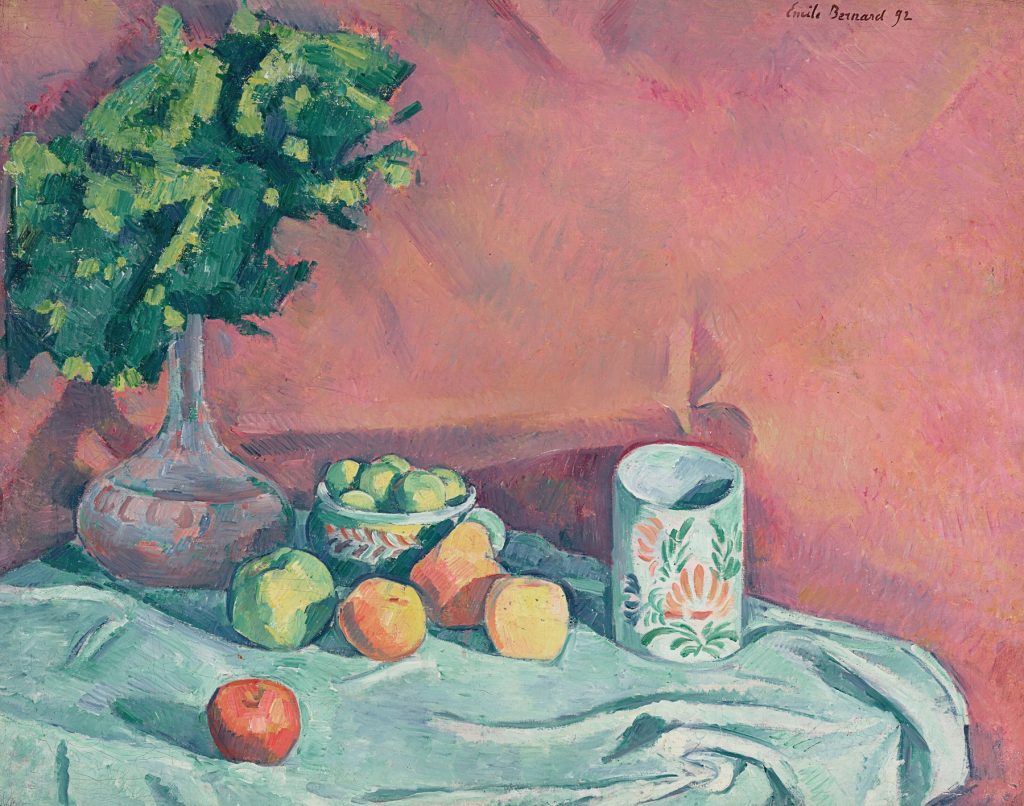
Emile Bernard, “Nature morte aux fruits, fleurs et tasse” (1892)
Helen’s forthcoming book Feels Like Trouble emerges from two decades spent working as a professor, writing coach, and author. In it, she examines how standards of literary excellence can reinforce existing hierarchies of power. What exactly, in other words, is being privileged through the ideals of ‘good writing,’ and whose values does that serve?
It was to joy to learn more about her work—and her own experiences in navigating those systems—through this interview.
Jana M. Perkins, PhD
Host, Women of Letters
Helen Betya Rubinstein is the author of two books, Feels Like Trouble: Provocations on Writing, Teaching & Power (October 2026) and The Case Against Rubinstein: An Anti-Fiction (2027), both forthcoming from the University of New Orleans Press, plus a cult zine, Eat Like Helen, and a booklet of lyric fictions, Because Sex Is a Story & Sex Is a Song. A writing coach in ongoing practice with writers across genre, Helen is also on faculty at The New School.
You can follow Helen at @helenbetya and pre-order her forthcoming book Feels Like Trouble here.

How did your childhood shape your ideas about what work looked like and what was possible for you?
Helen Betya Rubinstein: When I think about what work looked like to me as a kid, I think of my mother’s relief at getting to take off her work clothes when she got home. She was a lawyer who had never wanted to be a lawyer—she’d stumbled into law school when she hadn’t gotten into journalism school, hoping to become a writer. Perhaps what I learned from her example were the consequences of doing something that fit as uncomfortably as those stiff, scratchy outfits, which smelled like dry cleaning instead of like her.
My father, meanwhile, had left his family behind in a country he could not return to so that he could study engineering to the extent he desired. Sometimes, sitting on the couch in the evenings, he would ask me not to bother him even though he appeared perfectly available, gazing into space with his eyes half-closed. He was busy “working on a problem.” In him I found an example of work as vocation—the kind of work where a person has the privilege of devoting themself to chosen “problems,” and the pleasure involved in pursuing their solution.
For both my parents, work was primarily a way to achieve a material security that had not been available to their parents. Classically for the following generation, I often heard things like “you can do anything you set your mind to” when I was growing up; I was sometimes told this freedom and opportunity had been the reason for my father’s immigration. I took the dictate to heart, possibly too much so.

What’s the first thing you remember being good at?
Helen Betya Rubinstein: My grandfather used to tell a story about how, when I was about eighteen months old, I had impressed him by counting pairs of socks past ten. I don’t remember counting the socks, but the simultaneous discomfort and pride I felt on hearing the story is what I remember when I remember being “good at” things as a kid. In other words, I remember other people’s praise: friends’ parents impressed I could add multidigit numbers in my head, or my piano teacher’s thrill when she liked how I played. I don’t remember an inherent sense of pleasure in an activity that I felt I did to my contentment, for the pleasure of pleasing myself—except, perhaps, in writing.
I spent part of my tenth birthday writing at my desk with the door closed, in a notebook whose cover I’d glitter-pen’d in a way that delighted me. Concocting the big, forest-dwelling family I conjured on the page that day is one of my sweetest childhood memories.
Fast-forward to today. How did the path to what you’re doing now unfold?
Helen Betya Rubinstein: I wanted to be a pianist, a painter, and a cognitive scientist before I wanted to be a writer, but I always wrote, and I was always interested in pedagogy.
Throughout elementary and high school, my father had loudly questioned the way I was being taught, and when I got to college, the way writing was taught there had shocked and dismayed me so much that I ended up criticizing my first-year writing professor’s teaching in a similar vein. Being asked to slot my ideas into the formula she required felt unbearable. That was probably the first seed of my eventually writing a book about writing, but along the way I went through two MFA programs—one in fiction, one in nonfiction, both full of joys and frustrations—and achieved few of the milestones of literary success I had hoped for.
I worked with multiple literary agents over the years, who either had to stop agenting or could not sell my books, and I couldn’t get a full-time university job. I spent two years bouncing between artist residencies and friends’ houses while trying to finish a very old book project, but didn’t even manage to finish it within those two years. I adjuncted for more than fifteen years before I could shift to coaching other writers full-time, a job I stumbled into wholly by accident, and which I love more than I could have imagined ever loving a job.
Did you have any mentors along the way?
Helen Betya Rubinstein: I write in Feels Like Trouble about an experience I had with a college writing professor who insisted, “I’m breaking you to build you,” then took on the role of mentor, only to tell me, many years later, to stop writing altogether—which is to say, I feel conflicted about the idea of mentorship. (I’m looking forward to Tajja Isen’s book on the topic.)
Over the years, I’ve had a few other former professors who’ve been kind enough to support me with advice or encouragement, but no one to whom I would assign the more intimate, entangled title of “mentor.” By contrast, I once asked an older and more experienced writer friend if she might be a mentor to me, and she answered that she would prefer to be my friend. At the time this took me aback—it made me realize, to my shame, that I was asking her to give me something, in an unequal and imbalanced way—but I have so much respect for that answer now. Rather than guide me from a position of power or presumed expertise, she was insisting on a lateral mutuality.
How do you get your work in each day? What does that process look like, and what are the conditions that help you perform at your best?
Helen Betya Rubinstein: For me, the most important condition for getting writing done is being away from internet and phone—or even away from my computer, writing by hand on paper.
In a sense, I’m always trying to conjure the sacred hush of the first residency I ever did, when I felt so incredibly lucky to be gifted time and space that I didn’t dare look at my phone before dinner, and felt guilty each of the two times I checked email during those four weeks. Those kinds of boundaries feel difficult to imagine now (and not necessarily desirable), but I do relish the weeks I’ve been able to spend for many of the past summers up at an extremely rustic informal residency called Beth’s Cabin in New Hampshire—a no-phone-service, no-wifi, no-electricity, no-running-water situation. Though I walk or drive to get on-grid almost daily, it feels like I’m getting my brain cleaned. Time expands. Reading is more vivid. So much seems to happen on the page.
I’ve done what I can to conjure these same conditions at home, cordoning off one room—the only room with a door—as phone- and internet-free. It’s a kind of off-grid cabin within my apartment. I know from my work as a coach that people have wildly varying needs and proclivities when it comes to conditions for writing, but I do think a kind of on/off boundary is helpful for many of us, whether that means a dedicated space (or café) for writing, a candle/tea/lamp for writing, or a self-mesmerism practice like the one Ingrid Rojas Contreras describes, which I often find myself recommending—something that indicates, I’m doing this and only this right now, however short or long the “now” may be.
What are you most proud of achieving?
Helen Betya Rubinstein: At midlife, I’ve achieved few of the visible achievements that I once imagined would make me proud. Striving for so long forced me to change my sense of achievement, even my desire for it, and for the better; I think changing my ideas about achievement may be what I’m most proud of achieving.
At some point—thanks to a lifelong resistance to the acculturative projects of schooling, a desire to teach in accord with that resistance, and the support of books like Alison Bechdel’s Are You My Mother?, Alice Miller’s The Drama of the Gifted Child, and Terrence Real’s I Don’t Want to Talk About It—I set out to define my own literary and aesthetic values as a reader and writer, and began actively working to enact them on the page. As a coach, I work with writers to help them define their own sets of values, which I call a “measuring stick”: a self-made standard by which to evaluate oneself. To create (and live!) in accord with one’s values can be a huge—and deeply, inherently satisfying—achievement.
Was there a seemingly unremarkable moment or decision that proved, in retrospect, to be a turning point?
Helen Betya Rubinstein: In 2018, a friend invited me to lead a weekend writing retreat for a group of historians. I loved leading workshops and had a lot of experience doing so at that point, but I had very little interest in formal scholarship or even, I’m ashamed to say, in “history” as I then imagined it to be. (I had avoided taking any history classes in college, assuming they would just be bloated versions of the litanies of wars and treaties that had constituted history classes in school.) While excited to interact with a new kind of student, I mostly approached the workshop as a job.
The weekend turned out to be transformative for all of us. For many of the historians, it was the first chance they’d had to think of themselves as writers. For me, it was a thrilling chance to talk with people actively shaping our conceptions of the past about something that has long preoccupied me: the way our choices as storytellers determine our understanding of the world. We talked about the conflict between the goals of comprehensiveness and comprehensibility, between uncovering the past and making those findings legible, between truth-telling and storytelling. My friend and I ended up writing about the weekend in The Chronicle of Higher Education.
But the weekend actually changed my life, because it introduced me to the first person who would ask me to work with her one-on-one as a coach. Months later, I connected with another writer who wanted the same kind of support, and several months after that, another. It turned out that, to my surprise, I loved working with scholars to make their work more legible and more pleasurable. Over time, by word of mouth, something that had started off entirely peripheral became central to the rhythm of my working life.
What’s a commonly shared piece of advice that you disagree with, and why?
Helen Betya Rubinstein: A lot of prose writers, myself included, have been taught that it’s wrong to linger at the level of the line—that it’s dawdling, procrastination, perfectionism, “getting lost in the weeds,” failing to “see the forest,” and so on. This is sometimes, but not always, true. The line can also be where the writer is working out a problem. I call this “puzzling”: shifting word choice and syntax until the sentence suits the idea, like moving around the squares in one of those old number slide puzzles.
While it might feel better to do this intellectual work at a scale that’s more expansive than a sentence—which is why I often encourage very short, timed freewrites or fast-writes as interludes to puzzling—the act itself isn’t necessarily a bad thing.
Photo credit: Olivia Connolly
Perhaps in contrast to the above, a piece of advice I often give, which doesn’t counter common advice so much as it counters common sense, is that, while no one can manufacture the necessary time for writing, it is possible to bend time while one is writing. Specifically, writing more words can result in writing for less time. I call this “writing more to write less.” Rather than let the strictures of time persuade you there’s only time to tinker with a paragraph, you might insist on writing several wholly new pages, and find that doing so in a short sprint has stretched your pocket of time, and ultimately saved you several hours.
What book have you most often gifted to others?
Helen Betya Rubinstein: I don’t know about most often, but this year I’ve gifted Erica Stern’s Frontier to several friends who are interested in birth stories, birth trauma, and parenting. I find its genre-bending and sheer, urgent, honest quest for emotional and intellectual resolution entrancing.
Where can our readers find you?
Helen Betya Rubinstein: I’m at www.helenbetya.com and on most social media at @helenbetya. 🙂