“I’ve realized I need chaos and randomness”:
Anna Lena Feunekes on her career as an illustrator and author
April 9, 2026
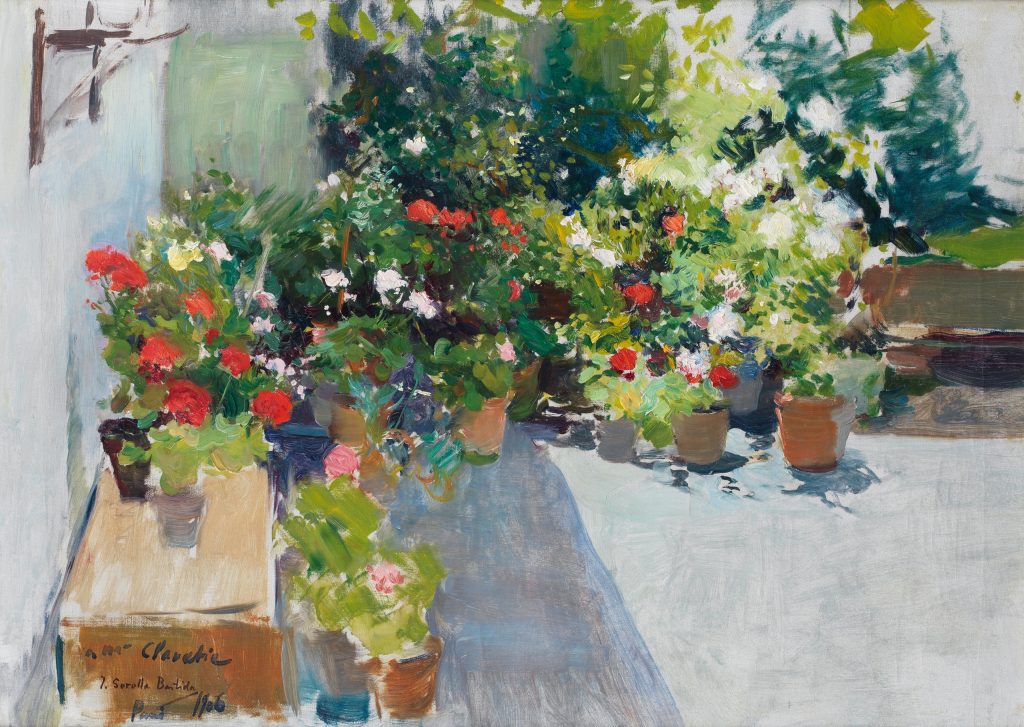
Joaquín Sorolla, “A rooftop with flowers” (1906)
I still remember how captivated I was by the richness of Anna Lena’s illustration style the first time I encountered her work. In ways that will come as no surprise to anyone who’s familiar with her multi-hyphenate status—e.g., as an illustrator, who is publishing books, who has been trained as a designer—she brings such a textured sense of vibrancy and depth to her artwork.
After we’d connected over this interview, I found so compelling getting to learn all about how her definitions of success and achievement had evolved over the years. I think it’s something a lot of us will relate to: the switch from the career-as-it-seems-it-should-be to the career that, after trial and error, you realize is more closely aligned with your wants and needs.
Jana M. Perkins, PhD
Founder and host, Women of Letters
P.S. I am so excited to be able to gift two copies of Anna Lena’s amazing book, Tasty Tales. Head over to our Substack to enter to receive your copy. 📚
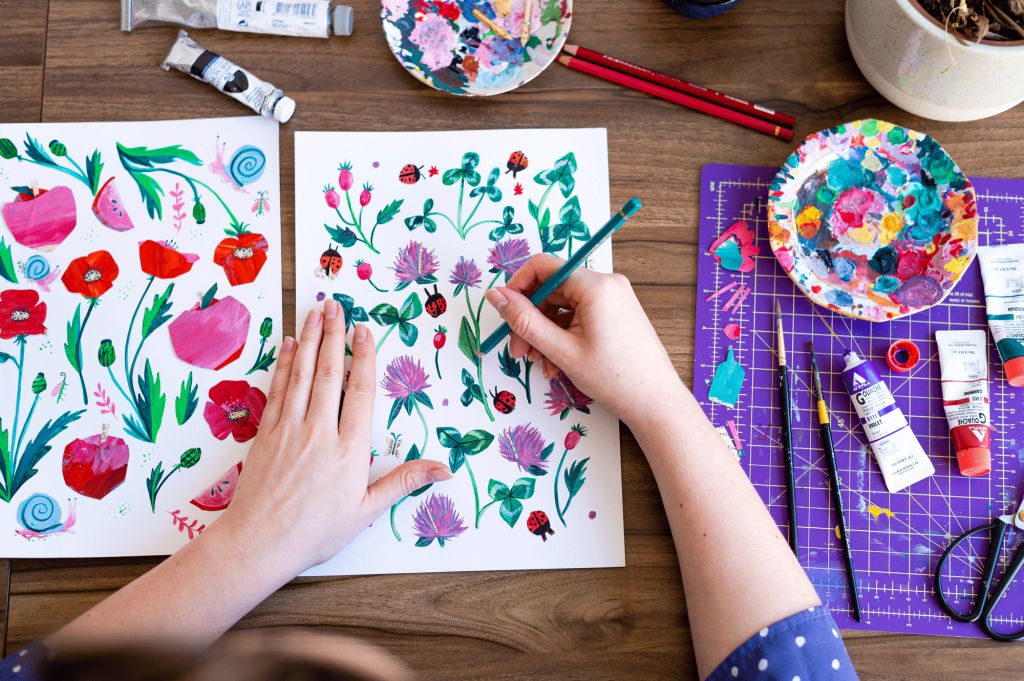
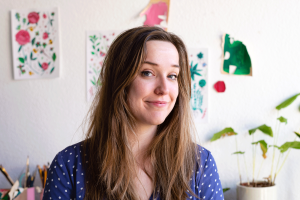
Anna Lena Feunekes has been writing, researching, and drawing for as long as she can remember, which naturally led her to a career as an author and illustrator. With a background in Industrial Design and research, she blends creativity with curiosity to craft nonfiction books that introduce kids to the wonders of history and science. Her illustration style combines hand-painted textures, paper collage, and digital tools to create rich, layered artwork. Beyond books, she teaches collage illustration in workshops and shares her creative process in newsletters. She is based in the Netherlands; you can visit her online at annalena.nl or on Substack at The Illustrated Kitchen.
How did your childhood shape your ideas about what work looked like and what was possible for you?
Anna Lena Feunekes: My childhood shaped my view of work more than anything else, I almost think.
I had a really hard time in my younger years, both socially and academically. I was bullied a lot as a kid. When I started failing tests and got estimated to go to the vocational track in Dutch schools—even though I was reading Homer and Sophie’s World and kid history books for fun—they had me tested by a psychologist. It turned out I was gifted, just with a rather skewed profile: extremely gifted verbally, ok-good at performative and mathematical thinking. The gap between them made traditional schooling difficult. That time of my life gave me a really shitty sense of self: I felt like the dumb kid in class when it came to math, yet I knew things other things did not.
I was quite sensitive as a consequence. I’m so grateful my parents took the time to really guide me through that. They saw me when the school system couldn’t, and they instilled in me a sense that I was intelligent and capable when I desperately needed to hear it. Their intervention of showing teachers those test results, advocating for me, and having me switch schools when they weren’t heard was a life-changing thing. This change helped me regroup, build confidence, and then allowed me to go to the pre-university track instead and be around kids who were interested in similar things. Things were looking up from then on. Though, let’s be real: I’ve always been a big freaking nerd and that never changed! Even as an adult, I often feel like the odd one out, but I’m fortunate to have found many friends over the years who are somehow the same.
What this experience really taught me was that persistence and believing in your own worth matters, even when people tell you otherwise. That lesson has helped me lots since, though not just when it comes to my outlook on work!
What’s the first thing you remember being good at?
Anna Lena Feunekes: Drawing. Isn’t that funny? It’s been there from the very beginning. Even when I was being harassed in class, I’d take every insult, except ones about my art. Don’t tell me any crap about how I can’t draw! I think that was my first lesson about bullies just saying mean things that aren’t true. It just didn’t occur to me before that that kids could be mean just for the sake of being mean.
Fast-forward to today. How did the path to what you’re doing now unfold?
Anna Lena Feunekes: I started freelancing when I was still in university, completely clueless about running a business or working with clients, but I just figured it out as I went. For about four years, I took whatever projects came my way through word of mouth—design work, illustrations, random commissions.
During that time, I kept pitching children’s book ideas to publishers and collecting rejections. I had all this time during COVID when I didn’t have to commute anymore, so I self-published a Dutch children’s book about a bundt cake fairy tale. I discovered I had the stamina and skill for the long haul. That little self-published book became my bootcamp and my proof of concept. After that, I got serious about finding a literary agent and reshaping my portfolio to focus on what I really wanted to do. Since then, I’ve published Tasty Tales, a kids’ nonfiction book about food history that’s sold worldwide, and I’m just finishing a book about birthday traditions around the world for DK Children that comes out in 2026, called Big Book of Birthdays.
Did you have any mentors along the way?
Anna Lena Feunekes: Absolutely. Before I fully committed to the freelance path, I went through a pretty severe burnout. I ended up hiring a former client—someone I’d done a book cover design for—to be my career coach, which felt vulnerable but turned out to be one of the best decisions I’ve made. It turned out I was feeling like I was bullied in my job at the time, which needless to say brought back a lot of pain that I could not articulate. That coach was so wonderful and helped me reframe my sensitivity as a strength rather than a weakness. He taught me to use it as a divining rod for what’s good and right for me. I still apply his lessons every single day.
I’m also lucky to have people in my life I can talk things through with—my husband and our friends have been such important sounding boards as I’ve navigated building a creative life. And my agent has been incredible. I’m grateful for all of them.
Tell us about some of the projects, ideas, or questions you’re currently working on.
Anna Lena Feunekes: Right now, I’m finishing up that kids’ nonfiction book about birthday traditions around the world—it includes recipes, which makes my food-loving heart very happy! There’s also a potential project for children’s theatre in the works, though it’s still early days and I’m waiting to see if it pans out.
Beyond that, I’m slowly chipping away at a historical graphic novel with LGBTQIA themes, combined with a big ‘No Kings’ theme. It’s a passion project that requires a lot of research, which of course I love. I also do custom recipe illustration commissions, drawing people’s family recipes and turning them into these beautiful keepsakes. That work feels really special because it combines my obsession with food history and nostalgia with helping people preserve their memories.
I always have a ridiculously long backlog of ideas, so there’s never a shortage of things to work on. The hard part is choosing what to pursue and what to let go of!
How do you get your work in each day? What does that process look like, and what are the conditions that help you perform at your best?
Anna Lena Feunekes: I’m going to be honest, I can be a bit robotic about it. Growing up, I had to learn to apply serious discipline to my naturally chaotic, associative brain, which was a major part of learning how to navigate school as a gifted person with a skewed learning profile. It wasn’t that I was bad at subjects; I wasn’t good at structuring work despite being very independent and self-directed. And that training has served me well as a freelancer!
When I know what I want to make, I’m easily motivated. I just sit down, make the first mark, and momentum takes over from there. But when that doesn’t happen naturally, it’s usually a sign that I need something: rest, new inspiration, or a trip to a museum with my buddies. My brain craves stimulation, whether that’s social or informational.
I preferably want to be learning all the time, and I’m blessed to have creative friends I can spitball ideas with—about writing, the Holy Roman Empire, European agricultural systems, politics, whatever we’re obsessed with that week. Those conversations refill my creative well. I’ve learned to recognize when I’m running empty versus when I’m genuinely ready to work, and to honour both of those states. Not that I don’t overshoot sometimes, don’t get me wrong.
What do you typically like to read, and what are you reading now?
Anna Lena Feunekes: I’m a history nerd at heart—give me a dense historical text and I’m a happy woman. My husband gave me The Habsburgs (Martyn Rady) as sort of a push present when I was due with our kid, and I brought it to the hospital in case I got bored during labor?! I think the kids call that delulu? Needless to say, I finished reading it only two years later…
But right now I’m bouncing between Why Nations Fail (Daron Acemoglu and James Robinson) and Dostoevsky’s The Idiot. When the Russian names get too overwhelming (sorry, Fyodor!), I need something else as a palate cleanser before diving back in. Also, I haven’t an economic bone in my body, so being able to better understand the world around me and articulate questions I have is a real plus.
What are you most proud of achieving?
Anna Lena Feunekes: This is such an interesting question for me right now because I’m actively examining what achievement even means. My brain is wired to get addicted to goals and stimuli; achievements are like crack to me. That drive can be wonderful, but it can also turn into restlessness if I’m not careful.
I’m trying to evaluate why I want to achieve something before I chase it. Something that’s helped me make sense of this recently comes from old guys disagreeing with one another: I’ve been thinking about Marcus Aurelius’ Meditations since reading it last summer, and the Stoic philosophers, and how they seemed to lack any real compassion—like this distant Jedi master trying to reject all emotions. Given my natural disposition to cry at the drop of a hat, it felt like a very alien way of living to me. Then I discovered Schopenhauer’s writing, who critiqued them on lacking radical compassion, feeling deeply with others as a way to live morally and make the world better.
Shifting my focus in life to radical empathy instead of running to keep up with burnout society is a point of pride for me. I think what I’m most proud of isn’t a specific milestone, but rather learning not to tie my identity to my work. Instead, I’m trying to just exist thoughtfully and be a good person as I move through the world. It’s harder than publishing any book, honestly, though it’s about as tedious in sorting out the little details!
How do you decide which opportunities to pursue and which to pass on?
Anna Lena Feunekes: I ask myself one key question when someone emails me about a project: would I want to do this even if it paid me nothing? Here’s another thing: anyone could theoretically do most creative projects alone. For me, I’m trained as a designer, I’ve self-published, I illustrate and write, and I have plenty of opinions. But I think creating in isolation misses something essential. Everything is better when made in community, with someone rather than just for yourself.
For me, my art is always better when it’s either for someone or with someone. But I have to feel genuinely drawn to that person’s voice or message. There has to be some kind of resonance. Does that make sense? It’s about connection, not just commission.
What’s something you’ve had to unlearn from your formal education?
Anna Lena Feunekes: I studied industrial design at technical university, and while that background isn’t directly applicable to what I do now it did teach me that I thrive when doing lots of different types of activities. But the approach was so systematic, so methodical, and I’ve realized I actually need chaos and randomness to create my best work.
The biggest thing I had to unlearn was ignoring my intuition in favour of strict process. I had to give myself permission to listen to my inner voice, to follow the god dang muse, to trust the associative leaps my brain wants to make. Not everything needs a system or a framework. Sometimes you just need to feel your way through.
When you think of women who have inspired or influenced you, who comes to mind?
Anna Lena Feunekes: Right now I’m really inspired by Amy Taylor from Amyl and the Sniffers. Aside from being an amazing singer and activist, her lyrics are like creative mantras when I work. “My energy is my currency” makes me feel seen in my neurodivergence and gets me through late-night research hyper focus, and “it’s just for capital, am I an animal” runs through my head when I’m standing in the drugstore holding overpriced Olaplex shampoo, urging me not to buy into bullshit. She channels this raw, unapologetic energy that I love. I feel connected to that.
Was there a seemingly unremarkable moment or decision that proved, in retrospect, to be a turning point?
Anna Lena Feunekes: Meeting my husband. I think he’s the best person on earth, and the path we have taken together in general has proven to be one of the most beautiful things I could ever have hoped to experience.
What’s a commonly shared piece of advice that you disagree with, and why?
Anna Lena Feunekes: “Do what you love and you’ll never work a day in your life.” I love what I do, truly and deeply, but it’s still work. It’s hard work, exhausting work, work that demands discipline and perseverance. The difference is that it feels meaningful, not that it magically stops being difficult.
I think this advice sets people up for disappointment. It makes them feel like failures when their passion still requires grinding effort and pushing through when you don’t feel inspired. Love doesn’t erase the difficulty; it just makes the difficulty worthwhile. Ctrl+C this advice for relationships, I guess.
How do you maintain momentum during slower seasons?
Anna Lena Feunekes: Honestly? I just do whatever I want. Sometimes it makes me money, sometimes it doesn’t, and I’ve made peace with that. I think slower seasons are actually when my best experimentation happens—that’s when I test new techniques, fall down research rabbit holes, work on personal projects that have been simmering on the back burner. Those feel unproductive in the traditional sense, but really they’re when I’m planting seeds for future work. You need fallow periods to grow good things. I guess it helps that I’m very headstrong!
Tell us about a time when you had to take a big risk in order to move forward. What did that experience teach you about how to navigate difficult circumstances?
Anna Lena Feunekes: I worked IT jobs on the side of my freelance work for a long time, but once I found my agent and the book projects started coming in I was burning myself out trying to do everything. Then another book proposal landed on my desk and I looked at my life and thought, “I’m plain tired. I need to quit.”
What that taught me is that the “safe” option often isn’t safe at all—it was destroying my health and my creativity. The scary option, the leap, actually turned out to be what honoured who I am and what I need to thrive. Risk isn’t always reckless; sometimes it’s the most responsible thing you can do for yourself.
How has your definition of success evolved over time?
Anna Lena Feunekes: It’s changed so much. Success used to mean hitting milestones, getting book deals, building a portfolio, getting a fancy bag for my laptop… achieving visible markers of “making it.” Now it means something much quieter and harder to measure: being able to look at myself in the mirror and know I’m living in alignment with my values, treating people well, and making work that genuinely matters to me. It’s about disconnecting my sense of self-worth from external validation and instead asking whether I’m being the person I want to be. It’s a much more sustainable definition, even if it doesn’t photograph as well for social media.
Are there any skills or interests that have turned out to be unexpectedly valuable in your career?
Anna Lena Feunekes: Yes! I started out thinking of myself as purely an illustrator, but it turns out that reading constantly and having strong opinions and asking endless questions is actually a pathway into being a nonfiction writer and illustrator simultaneously. My curiosity and my inability to shut up about topics that fascinate me—those have become professional assets. (Who knew being nosy and opinionated AF could be a career?) It’s also much more valuable for publishers to offer them an enticing product instead of being one of 5,000 illustrators in their roster who can do some one thing for them.
What book have you most often gifted to others?
Anna Lena Feunekes: I haven’t gifted it the most often, but I’ve definitely tried to get a lot of people to read At Home: A Short History of Private Life by Bill Bryson. A friend lent me his copy and I absolutely devoured it. While reading it before bed, I have interrupted my husband’s reading a bit too often, repeating facts from the book to him. It is his sad, sad fate… It’s exactly the kind of book I adore, packed with historical details about everyday life that completely change how you see the world around you. The mundane becomes magical.
What’s something you’ve recently changed your mind about?
Anna Lena Feunekes: I’ve become much less tolerant of people saying harmful things about others. Where I live, there are a lot of so-called liberals who only really support people who look like them. And then there are people who just hate everyone but themselves? I think that’s a hypocritical and cowardly way to be, and I care a lot less about offending them now when they ask my opinion or their behaviour demands a response. I used to think keeping the peace was more important, but I’ve realized that silence is often just complicity dressed up as politeness.
Where do you feel the most scarcity in your life? Where do you feel the most abundance?
Anna Lena Feunekes: Scarcity: time, always time. I have so many interests and I grieve that I can’t pursue all of them. I’ll never learn all the languages, read all the books, master all the crafts I want to try. Learning to let things go, to accept that limitation, that’s one of the hardest lessons of being human, I guess?
Abundance: I grew up privileged. I had family, access to education, a safe home, enough to eat. I try to spend my knowledge, energy, time, and love wisely, to funnel it back into the world around me.
What’s been an important part of your journey that others often miss?
Anna Lena Feunekes: People mistake my (creative) confidence and energy as an adult as a sign that nothing bad has ever happened to me. Or as a sign that because I don’t complain a lot, that there is no strife in my current existence.
The bullying and feeling stupid and inadequate shaped who I became as an adult, but I don’t like to attribute them as a thing of causality, and more as something that just is. I think I’m comfortable writing about it because I’ve come to accept myself, and even sharing it publicly feels like a neutral act. I’m not obliged to share it with anyone, but then again there is no way to hurt me with the information. If anything, I hope it helps someone who can use some lesson from it, and to approach others with openness and curiosity. You never really know someone’s story.
If you were starting now, what would you do differently?
Anna Lena Feunekes: I wouldn’t wait for permission from anyone, not publishers, not teachers, not clients. I’d start by giving myself permission. I wasted so much time waiting for gatekeepers to validate me before I felt I could really pursue what I wanted. The moment I started acting like I was already the professional I wanted to be, everything changed. Confidence isn’t something you earn; sometimes it’s something you decide to embody, and then you grow into it. Quite like accumulating knowledge: just start by asking the first question.
What keeps you going?
Anna Lena Feunekes: A desire to connect with others, to change the world for the better, and to make art that means something. (And okay, maybe a little bit of a burning rage at capitalism, but we can file that under ‘motivation’.)
I want to leave things better than I found them, whether that’s through books that spark kids’ curiosity, illustrations that preserve someone’s family recipe, or just doing my best at being a kind and thoughtful human in my daily interactions. I hope that makes sense; it does to me on most days. And when all else fails, I cook a really huge lasagna and invite over my friends. That tends to do the trick!