“I decided to upend my very stable life”:
Allison T. Butler on her career as an author and lecturer
June 4, 2026
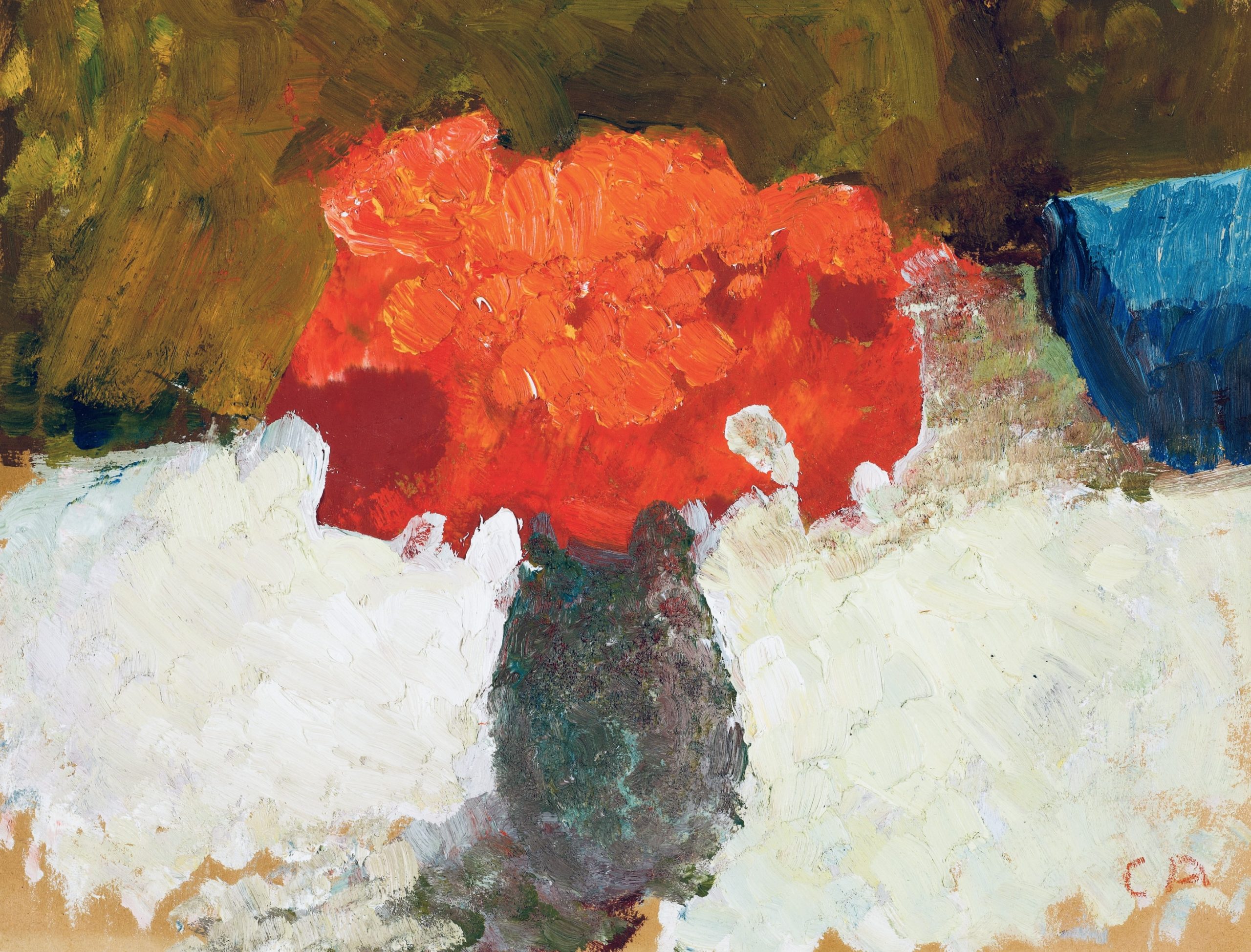
Cuno Amiet, “Blumenstillleben mit blauem Buch” (1955)
With her latest book, Allison offers a rigorously researched and highly readable account of how women throughout history have been simultaneously centered and yet silenced in pop culture.
She revisits the distorted narratives that took shape around the lives of women like Britney Spears, Anita Hill, and Sinead O’Connor to highlight the ways that media outlets ignored context, omitted facts, and played on misogynistic tropes in their portrayals. From there, she retells their stories with depth and nuance, before concluding with a set of actionable media literacy skills that can help us all to do better at recognizing and resisting these kinds of narratives going forward.
I’m grateful to have been able to learn more about her own life and career in this interview.
Jana M. Perkins, PhD
Host, Women of Letters
Allison T. Butler is Senior Lecturer and Associate Chair in the Department of Communication at the University of Massachusetts Amherst. She is the Vice President of the Media Freedom Foundation and the author of The Judgment of Gender: How Women are Centered and Silenced in Pop Culture, published by The Censored Press.

How did your childhood shape your ideas about what work looked like and what was possible for you?
Allison T. Butler: I am the youngest of five children, so I’ve always had so many people to look up to, to copy, and in whose footsteps I could follow.
We were raised by a dad who worked 9-to-5 and a mom who stayed at home until she determined that I—as the youngest—was old enough to be alone in the afternoon, after school. My mom worked as a labour and delivery nurse prior to being married and having all of us; she returned to nursing first in a clinic for low-income families and then in private practice for a reconstructive surgeon. My mom did not officially retire until age 85—not because she had to work, but because she loved her work.
That taught me from a young age that “work” meant doing something that was continuously inspiring and motivating. Our parents modelled that we could spend time (and earn enough money!) by following our interests—what a privilege! That my lived reality is the work of education is something I’ve never taken for granted.

What’s the first thing you remember being good at?
Allison T. Butler: I was an obsessive reader as a kid. I would read anything and everything. My parents were also big readers. There are bookshelves in every room of their house and there have always been bookshelves (or wobbly stacks of books!) in every room in any place I’ve lived.
I was, and remain, a democratic reader: highbrow classic fiction, mystery novels, literary novels, nonfiction about war, nature, health, YA fiction, entire oeuvres of an author, memoirs, biographies, each entry in a series, magazine articles, poetry, the newspaper, and so on. As a child and as an adult, I can get lost in my reading and lose total track of time. I was an early, good reader and was raised in a home where we were encouraged to talk about what we were reading. Critical analysis was baked into me from a young age.
Fast-forward to today. How did the path to what you’re doing now unfold?
Allison T. Butler: At the end of elementary school, I was invited to test into a ‘gifted and talented’ (the language of the day) magnet program, focused on interdisciplinary learning and what we would now call media literacy (but didn’t quite have that clear of a name then). The year I started was the first year of the program, so we were both who our teachers tested this pedagogical risk on while, simultaneously, our teachers drew from our interests and curiosities.
The ability to learn this way felt normal because it was my everyday life for the 6 years of middle school and high school. It was not until I got to college that I started to see my education, thus far, as something really special. I spent a fair amount of time in college, then in graduate school, studying education, interdisciplinary learning, critical pedagogy, and, most importantly for me, critical media literacy. While my professional goals and career trajectory have ebbed and flowed over the years, there is a consistent throughline focus on critical media literacy that I can very clearly trace back to the 7th grade!
Did you have any mentors along the way?
Allison T. Butler: Indeed! I’m so lucky to have had so many good teachers! So many of my personal and professional choices over the years have been decided alongside the tiny little voices in my ears, still whispering lessons learned from middle school, high school, college, and graduate school teachers.
I’ve been so lucky to have teachers who were so open and accepting, even in the face of terrible adolescent brattiness; teachers who respected students’ needs to discover things on their own time, who encouraged our curiosity, supported our interests, and invited us to think big; teachers who modelled how to move through difficult times with grace, always taking the high road. I am not exaggerating when I say that I think of Jan Guttman, Christopher Lloyd, and Ted Magder on a near-daily basis. I am definitely a person who believes that teachers make a huge difference and I work hard to embody that in my own work.
(And, to be honest, I’ve had some awful teachers as well—I’ve learned just as many life lessons from them about what not to do. Though they shall remain unnamed, I think of them regularly as well when I’m trying to determine how not to behave!)
Tell us about some of the projects, ideas, or questions you’re currently working on.
Allison T. Butler: Since I finished writing The Judgment of Gender, so many more women have been put under the spotlight. I’ve been working on op-eds and essays about these women to bring their stories to light.
I’ve been challenging my brain to find the truth and humanity in the stories of women with whom I disagree politically and socially. In these fractious political times, I want to utilize the intersection of critical media literacy and feminist analysis to model healthier and more productive ways to disagree. I’m not interested in a hive-mind where we all blandly and blindly agree on everything—rather, I’d love if our society could, with compassion, find ways to respectfully engage in dialogue about our differences. That’s how we will grow!
How do you get your work in each day? What does that process look like, and what are the conditions that help you perform at your best?
Allison T. Butler: I make handwritten to-do lists and check off each item as it is completed; I find it stress-relieving to do this by hand. Sometimes, doing nothing is the most productive I can be—giving the brain a break invites it to file away the overwhelming quantity of information that we take in on a daily basis. After some downtime, I am significantly more focused.
I try to prioritize my health and wellbeing through exercise and some sort of meditative activity. Spending time in nature soothes my soul and builds a stockpile of good feelings. A good hike definitely makes me more productive for the next few days. I find walking my dog very meditative. She’s an elder lady, so we don’t go for the long walks or hikes we used to do in her younger days, however I’ve found that watching her catch a good sniff is incredibly soothing. She’s in her element when she is sniffing and I love sharing that joy with her.
What do you typically like to read, and what are you reading now?
Allison T. Butler: I am an avid reader. There are stacks and shelves wobbly books all over my house and in my office. I am so lucky that my work involves reading; what a treat that I can be on the couch, snuggled with my dog, reading a book, and that is part of my job!
I always make time for fiction, and am someone who reads before going to bed, which means that sometimes I get through one or two sentences before I fall asleep. I have a stack of non-fiction books on the current state of higher education and a separate stack of non-fiction books on women and patriarchy; both stacks will be tackled this summer. We live in difficult times that are exponentially more difficult for our young people. I am hoping these stack of books will help me in my teaching and will expand the work of Judgment of Gender.
For my personal reading, I just finished reading My Friends by Fredrik Backman and am not ready to leave the beautiful, layered way he writes his characters, so I’m going to do a re-read of the Beartown series so that I can spend more time with his writing!
When you think of women who have inspired or influenced you, who comes to mind?
Allison T. Butler: I dedicated Judgment to my mom and her lifelong best friend. These two amazing women met at age 15 and lived remarkably parallel lives, including going to nursing school together, getting married within six months of each other, and bearing the same number of children (5 each, all around the same ages).
When us 10 kids were young, our families would travel together or travel to visit each other. The moms would just as often head out on their own adventures. I have no doubt that the reason why I have the friends I have today is because of watching their friendship over the years.
Was there a seemingly unremarkable moment or decision that proved, in retrospect, to be a turning point?
Allison T. Butler: When I was in college, I worked on a paper about the need for media literacy in schooling, largely based on my own education. I found a book in my college library by an author called David Buckingham and it spoke to everything with which I was grappling. I remember feeling that I was no longer alone, fighting an uphill battle, that I had a vocabulary for what I was trying to write about, and, from that book, could see a path for what might come next for my schooling and career.
In graduate school, I was able to study with Buckingham and he is someone I’ve stayed in touch with since. I’ve written a book about him and he has read and blurbed my manuscripts. I never knew that accidental find in the library stacks would have such an influence on the trajectory of my work!
Tell us about a time when you had to take a big risk in order to move forward. What did that experience teach you about how to navigate difficult circumstances?
Allison T. Butler: There was a time in my life where, on paper, things were pretty good: I had a safe home, good friends, a steady job, a fair amount of personal flexibility, and a great dog. But I was unhappy. I could not quite articulate what, exactly, but something was making me feel stuck.
Without a plan, without a job, without a place to live, I decided to upend my very stable life in NYC and move to Massachusetts. I camped out in my brother’s basement and spent a great deal of quality time with my amazing then-10-year-old niece. As scary as it was to be an adult, living in someone else’s home, with no clarity on what was to come, I never doubted that it was the right decision. I met and befriended amazing people and landed a job at UMass that, over the years, has enabled me to mix all my professional interests. My husband and I are part of a community of courageous and thoughtful friends and family.
Where do you feel the most scarcity in your life? Where do you feel the most abundance?
Allison T. Butler: I live a very secure life and, especially these days, in times of global warfare and our own descent into authoritarianism in the United States, I recognize that what I live as “scarcity” is still quite luxurious compared to what is happening around the world. As gas prices continue to rise, I realize that I am paying for a war with more expensive fuel in my car; I am not paying with my life, I am not losing my home, I am not losing my family. I would say that I feel the most scarcity in my trust at the state of the world. I have no doubt that democracy and social justice will prevail—but at what cost? And on what timeline?
That is equally and importantly counterbalanced by where I feel the most abundance. I am rich with friends and family. I’m a billionaire many times over when it comes to deep-depth colleagues, friends, and family. I work with really good people, many of whom have become valued and trusted friends. I have dear friends with whom I share laughter, struggle, adventure, and quality time. I have family that are rock-solid human beings, especially our next generation who are moving so conscientiously through their days, bearing the weight with grace of the changes they will need to make to keep our planet healthy.
If you were starting now, what would you do differently?
Allison T. Butler: Oh, I wish I had a poetic answer for this! I think my answer is pretty stock: trust myself sooner. Trust the process. Trust that “success” and “achievement” look different on everyone and happen at different times.
When my students stress about getting post-grad jobs or are bummed that their friends seem to have it more together (whatever “it” is!), I remind them that college is the only weird, magical time of their lives where they will be surrounded by people their own age. Once college is done, they will encounter more people on different paths in their lives, with different degrees of progress.
What keeps you going?
Allison T. Butler: Nature. My dog. Being outdoors. A good dinner with great friends. Time with my mom. When my husband says something so hilarious. Maybe not in that order, maybe the order shifts depending on the day, but no matter how bad the day, if any of the above happens, I am healed.