“I became a person who took those kind of risks”:
Alia Hanna Habib on her career as a literary agent and an author
February 26, 2026
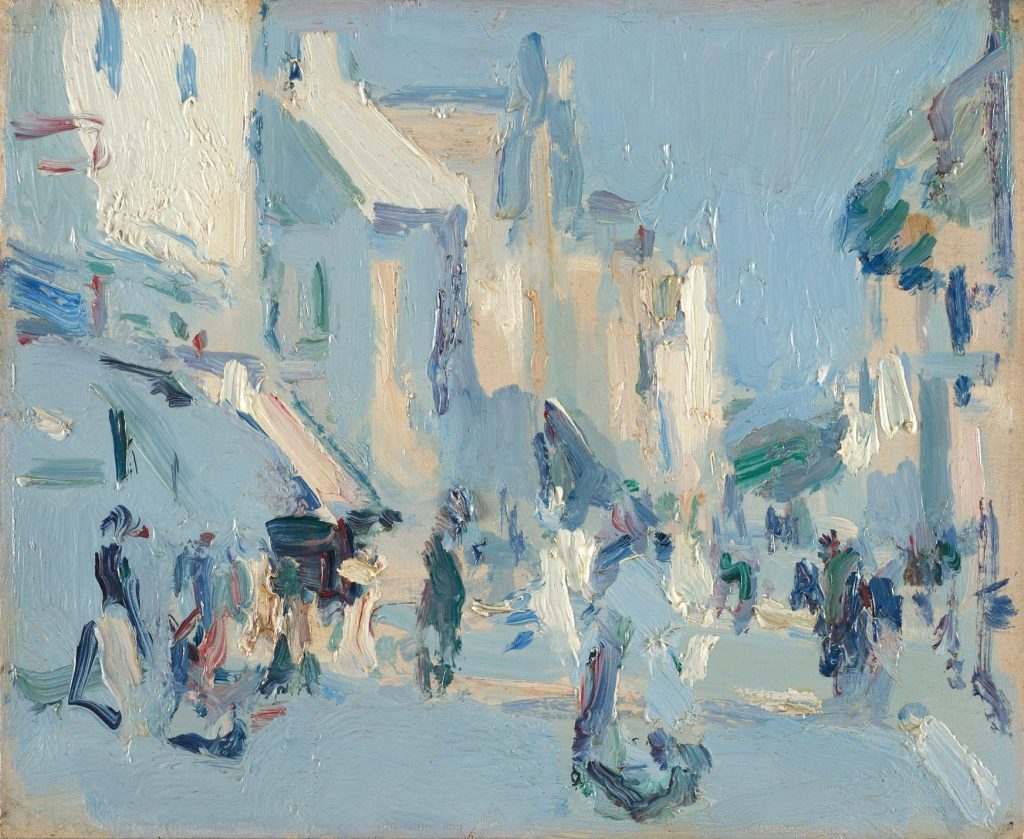
Samuel John Peploe, “Paris-Plage” (c. 1907)
You can listen to this interview on Apple Podcasts or Spotify.
The publishing industry occupies a unique space in our cultural landscape: it is ubiquitous in its influence, and yet persistently opaque in its operations.
Alia has been working to change that. In addition to representing some of today’s most successful authors as a literary agent, she has also taken on the task of demystifying the world of publishing with her debut book, Take It From Me: An Agent’s Guide to Building a Nonfiction Writing Career from Scratch.
In it, she details each step of the process with characteristic generosity of insight. Her account offers precisely the kind of peek behind the curtain that will interest even those who aren’t themselves in publishing, revealing, as it does, an insider’s perspective into how the books we love make their way into the world.
Jana M. Perkins, PhD
Founder and host, Women of Letters
P.S. With this interview, we have officially launched Season 3 of Women of Letters! I’ll be sharing more about what’s new this season in the coming weeks.
To get us started, I am so excited to be able to gift two hardcover copies of Alia’s amazing book. Head over to our Substack to enter to receive your copy. 📚
Alia Hanna Habib is a literary agent and Vice President at The Gernert Company, which she joined in 2017 after starting her publishing career as a publicist at HMH and working as an agent at McCormick Literary. She is the author of Take It From Me: An Agent’s Guide to Building a Nonfiction Career from Scratch and of the publishing-themed Substack Delivery & Acceptance. Among the New York Times-bestselling and prize-winning clients she represents are Clint Smith, Nikole Hannah-Jones, Lauren Oyler, Nathan Thrall, Merve Emre, Adam Serwer, and Hanif Abdurraqib. She is on the board of n+1 literary magazine and on the creative council of Aspen Words. She was profiled by New York Magazine for their special issue on “The 49 Most Powerful New Yorkers (You’ve Never Heard Of).” She lives in Brooklyn.

How did your childhood shape your ideas about what work looked like and what was possible for you?
Alia Hanna Habib: The fact that work looked so different in my childhood than it looks like in my adult life is one of the reasons I actually am so interested in talking about work, in that I view work—my own work—with a kind of double consciousness.
I grew up in a very working-class home, and like a lot of people who don’t have a lot of money I went to work with [my parents] all the time. We didn’t have a babysitter. If I had a babysitter, it was my grandmother. So in the summer I would go to my father’s bar and hang out there all day with a book. My father was a bartender at a hotel, so I would go to the hotel like this little Eloise and sit at the bar, and my dad would make me like a virgin piña colada. I read all day, and I would talk to his bar customers.
The idea that someone would work in publishing—the only concept of that was from television, you know? All of which is to say that I don’t take anything about my job for granted. Even though I’ve only, as an adult, ever worked in an office, in the kind of jobs you need a college degree to do for the most part, I’m not at all unaware that this kind of job is not a given.
So I had two things I thought about with jobs growing up. The one is that my mom was a secretary, and it was very important to her—she told me, growing up—to work in an office. That was her idea of success. Her father was a coal miner, and he didn’t make it past the sixth grade. Her mother worked in a cigar factory. My mom had a very difficult childhood, and she wanted a job where she was clean. She wanted a job where she would put on clothes and be respected and be clean. And my father, it was very important to him that he got to wear a nice suit to work. He would get really dressed up to bartend. And, again, his father also worked at a coal mine. They had a lot of pride in their work, and a lot of pride in how they presented themselves at work.
I was very aware of the physical challenges of their work, particularly my dad’s job. My dad was a health nut, but he worked in a smoky bar, and he died of lung cancer from secondhand smoke. And everyone on my mom’s side, they all died from their jobs, you know? So I get to work—I mean, this is my office. Like, it’s gorgeous, right? I have this view, I’m on a terrace. If you look that way, you see the Hudson; if you look that way, you see the East River. It’s stunning. And I don’t take any of it for granted. But in terms of how to navigate this space, to navigate working in the kind of job I work in—none of that was taught to me.
My parents didn’t have this kind of job. No one I knew growing up had this kind of job. I had to learn it, and I had to learn the social norms. I had to learn the language, I had to learn how to conduct myself professionally, and I had to learn it by being really observant and listening and watching.
Jana M. Perkins: I’m really struck by you saying that your mom had such explicit conversations with you about work. I feel like that’s rare for a child to have had.
Alia Hanna Habib: I take it for granted in some ways. My mom’s a talker. I’m a talker, too. I think that my mom always wanted a lot for me, and she could not have conceptualized the job that I have now—again, a literary agent. But I think that she wanted to give me a sense as best she could that I, too, would someday work, and that my work could be a source of self-respect.
It never occurred to me not to work. I started working when I was so young. I mean, before it was legal to work, I worked under the table. But I knew for both of my parents that they saw a job, and the way one presented oneself professionally, as a way to achieve self-respect. I saw the self-respect that my mom got from her job, a job that many people would consider quite menial, and I felt proud of her because of the pride she had in her own job. She was so proud of being a really good secretary. She always said that she was a really good secretary, and my dad always said he was a really good bartender. And he was a really good bartender.
Jana M. Perkins: I feel like that’s another really important thing for children to see—not only that their parents are working, but that they are proud of what they do.
Alia Hanna Habib: Yes.
Jana M. Perkins: You know? And to have that consciousness that there are different kinds of work, that it isn’t just this nebulous thing where, like, it’s The Sims or something, where your parents just leave and then you don’t hear anything.
Alia Hanna Habib: No, and I’m actually really grateful that I had a pretty nuts and bolts sense of what my parents did all day, in part because they took me to work and they talked about work all the time. I’m a person who talks about work all the time. But I think, in my dad’s case, he found his work interesting. He loved being a bartender. He had these colourful customers; there was always shenanigans at the bar. He was very proud of his ability to read a room and to interact with lots of different types of people and make them comfortable, to make a really good drink, to manage a bar, to manage the space that he was in.
My mom was really proud of—as she saw it, a good secretary anticipated the needs of their boss, and understood their boss better than they did. So I think, in both of their jobs, they had a strong sense of a social IQ, so to speak. That was always communicated to me as a value. I actually hadn’t thought about it until you asked me, that my parents being very interested in their own jobs—jobs that I think a lot of people wouldn’t find that interesting—made me someone who’s always interested in work.
I come home from work and I wanna talk about work. And I don’t think that’s a bad thing. I don’t. I think some people valourize a kind of work-life balance, where you come home and you put work away. But because of my relationship with my job, my work is so tied to how I think about myself and how I go through the world. Often, I come home, and I do wanna talk about what happened with my authors, or a problem I had, or something I was reading and how it affected me.
My parents were very much like that. They weren’t people who came home from work and it was like work never happened. It was like, “This interaction happened,” or, “My boss is doing this,” or, “This was my challenge today.” And I actually am really grateful that that was given value.
I should say, too—this is not to promote myself, but—I have a Substack, and I interview fellow publishing workers. I love Studs Terkel, I love books about working, and I’m interested in how other people work. So I like talking about work, obviously, and I didn’t even really realize it till we started talking about it, but I’ve been talking about work since I was a child.
Jana M. Perkins: I feel like it’s an under-explored aspect of our society, given that this really is where people are spending the vast majority of their time every week.
Alia Hanna Habib: Well, I think that there’s very good reasons that we push back on having your job not be your entire identity. To have things outside of work that are important to you—your boss is not your family. Those are really important things to internalize for your own protection as a worker. That said, you know, there’s a reason the TV show Severance hits us so hard.
If you completely sever who you are during work from who you are at home, you’re going to have a very bifurcated existence in a way that I think is unhealthy, or would be unhealthy for me. Because, yes: if the time that I spend at work isn’t meaningful to me, then a huge chunk of my life isn’t meaningful. And I’m very lucky. I love my job. I do a job that’s really interesting, but I still feel like myself at work, and I’m lucky that I do that. But it also means that, at the end of the week, I spent 40, 50, 60 hours at work—thank god not 60 hours usually—it doesn’t feel like I was a different person during those times.
That’s my real life. The interactions I have at work are me, and my interactions with my authors, that’s me. It’s not some separate thing. I’m not severed from that person; it’s who I am.
Jana M. Perkins: Well, I’m really excited to talk more about your job—your jobs.
Alia Hanna Habib: Too many jobs.
Jana M. Perkins: But they all, I think, work together in such really interesting ways. So I’m excited to hear more about that.
You said that you were a big reader as a child. Was your household, more generally, a literary household? Were there books around? Was reading important?
Alia Hanna Habib: Yes. My father wasn’t a huge reader, but he did read a lot of periodicals, and at the bar my father would always—every morning he would go and pick up newspapers. I grew up in Pennsylvania, but he would pick up the New York City tabloids and bring them to the bar. And I loved reading the tabloids. I know everything about 1980s tabloid New York, and I was just fascinated by this world. So actually the way this came up is, during our recent mayoral election, Curtis Sliwa—who was a fixture in 1980s tabloids New York—I know everything about Curtis Sliwa, because I was reading about him when I was 10. Normal, normal.
My mom was a voracious reader, and she loved books. I had very strict parents: I had to do a lot of chores, I had to do really well in school, but I could get away with more at home if I read regularly. No one would harass me to do chores, or to clean the house, or to do the many things you have to do if you’re a good Syrian girl—like go visit old Syrian people and bring them food—if I was reading. And I was always reading.
My mom would constantly recommend books to me, and she had many books that she loved that she would recommend to me that were not age appropriate. I read all of those, like, steamy, 1970s, 1980s novels, like Judith Krantz, The Clan of the Cave Bear, and Thorn Birds—these real potboiler novels. But also read classics. I read Wuthering Heights when I was in middle school. I read Gone With the Wind. When I read Gone With the Wind, my mom was really concerned about its racist ideology, and so she made me read Roots as a way to, like, counter the myth of the lost cause that is idealized in Gone With the Wind.
My reading education was not at all systematic, but I was constantly reading as a kid. I wanted to do something literary with my life, but I didn’t know writers. It was a literary household in that my mother was a reader, but it wasn’t like we knew writers. I didn’t grow up in a place where writing was a job that people had, but I thought that it was a job I would have one day.

What’s the first thing you remember being good at?
Alia Hanna Habib: It’s so funny—when you asked that, I didn’t actually think of writing. I just went with my instinctive answer, which was when I was really little my parents took me to see a play. I went to see Annie, and I loved it, and I said, “I wanna do that.”
I just wanted to be on stage. I wanted to be an actress when I was little, and so I started auditioning for plays, just locally. I didn’t even think I was good, but I felt very comfortable being on stage. I think that’s the first thing I remember being good at, is that this thing that makes other people nervous—public speaking, being on stage, performing—it doesn’t make me nervous at all, perhaps because I started doing it when I was so little.
It’s not something you would necessarily think makes one good at the kind of job that I do now, but it does in that if there’s any kind of presentation element, or that I have to be interviewed by you, or I have to go on book tour, I feel very comfortable public speaking. So I would say any kind of public speaking, public performance.
Once I learned to read, it was obvious that I liked writing and that I liked reading and I was good at it. I was so bad at so many things. I was terrible at every other thing. Everything: sports, math, science, basic social interaction. But I was a very good performer, and I was good at anything books-related.
Jana M. Perkins: Was there ever a thought for you that, like, “I would pursue this professionally”? Did you go to acting camp?
Alia Hanna Habib: No, I mean, the opportunities were so limited where I grew up, in this very working-class town, very working-class school. We didn’t have a theatre club. We didn’t have a drama club. But I did community theatre, and I couldn’t even know about anything like a theatre camp. I would love—I was just saying to my fiancé that what I want for Christmas is for someone to send me to theatre camp as an adult. I haven’t acted since I was a kid, but oh my god I would love it. I went to a really bad religious camp, and the idea that I could put on a show and sing and dance—I haven’t done that since I was a kid.
But I was in a bunch of musicals as a kid, and, I mean, I don’t think I was very good. I also think that there was a kind of racial element, which made it harder for me to get roles. I went out for Sound of Music, and they were like, “No one’s gonna buy you.” There was not race-blind casting then. And then I was in a play called The King and I, where I played a small Thai child. I’d be so embarrassed if someone saw the photos. Like, they put us in yellowface. This was, again, the eighties in Wilkes-Barre, Pennsylvania. So the kind of things that were available to me—like, whenever there was a role that was a little bit exotic for a child, they would give it to me, but I couldn’t be Annie.
I actually don’t have a very good point, but I loved being in community theatre as a kid. I loved the production of putting on a show. I loved interacting with all these creative people. I loved wearing a costume. I loved all of it. And I did theatre whenever there was an opportunity, basically until the middle of high school. But there weren’t a lot of opportunities.
When I went to college—I don’t know why—I went down the literary path and majored in English. But I do think it’d be so fun, just for fun, to take an acting class now. I have no reason to think I’d be good, but I think I would really enjoy it.
Jana M. Perkins: Tell me more about this time in college. What was it like having been a reader and then going, essentially, on the path to do that professionally?
Alia Hanna Habib: I loved college. And I did not like high school. High school is compulsory; you don’t have a lot of choice in what you study. And I had to take all this stuff that didn’t interest me that I wasn’t good at. I just really struggled in math and science, and I knew that in college I could have choices.
I knew I wanted to be an English major first semester. I knew that I was really interested in 19th-century novels, so immediately, my first semester, I took a Middlemarch workshop—a Middlemarch college seminar. If anything, I over-indexed in English classes. If I can do it all over again now, knowing I had my whole life ahead of me to read novels, I would take other classes: I would take history and art history and film and other things that interest me now as an adult. But it was incredibly pleasurable, and I couldn’t believe that I got to do this.
I went to Barnard, here in the city. I’m first-generation college, so many things about it were culturally quite alien to me, quite shocking. I remember I was on the train—I should say, my first year, I went to a different school. I went to a small liberal arts college in upstate New York called Bard, then I transferred to school in the city. My first semester in college, I was on the train to the city, and there was this boy I had a crush on that’s on the same train as me. He was reading Sartre, and it was this beat-up old copy, and he said, “It’s my father’s copy. It has his notes in it.” I couldn’t—like, my father read the New York Post. I couldn’t even conceptualize that your father would have read this.
My parents couldn’t give me any advice about things like courses, or what I should be taking. I’m getting married, and my future husband’s an English professor, and his son is in college right now. And he was just home over break, and we were all talking about his classes, and what he’s gonna take, and what he’s gonna major in, and we all had an opinion. He’s taking this, like, Irish drama class, and we’re all so excited to talk to Ben about, like, reading Beckett. And that was not what it was like. I very quickly felt very different from my parents, because they couldn’t even understand what I was studying.
But it allowed me to have remarkable independence. In some ways, I was totally free. Nobody was weighing into what I did all day; nobody was telling me what to do. I just followed my own interests, and I kind of made my own way. I got close to a bunch of my professors because I was desperate for adult role models. And I also started to help myself out financially. I babysat a lot through this babysitting program we had at Barnard, and I was constantly in these apartments on the Upper West Side and it was like, “Oh, that’s a model of what my adult life could look like. I’m gonna live in an apartment in the city someday, with bookshelves and mineral water in the fridge and work in an office.”
That’s sort of what gave me a model of adult life. My experience of college—it was my first time away from home, my first time being allowed to follow my own intellectual interests, a way to assert my identity as a reader, as someone who was very intellectually engaged. It was transformative. But I also had to do a lot of kind of interpretive work of being, like, “What is this weird world where everyone else, their parents went to college, and no one else is as worried about money as I am?” I was constantly broke, and not in a broke college kid way—in a broke, like, “How am I gonna buy groceries?” kind of way.
It was the constant pressure of that. But it was also amazing. And I was in New York City, like, reading Jane Austen. It was enchanting.
Jana M. Perkins: Okay, so it sounds like there wasn’t necessarily a sense that you were going to college to become an X. It was more that you were immersing yourself in an interest and kind of trusting that things would work out from there.
Alia Hanna Habib: Totally. And part of that is generational. I think that my generation was much less professionalized. I’m 48, so I graduated in 2000. I see what our interns are like, and how pressured they are to figure things out. It was in part because my parents were so clueless that, I mean—they wanted me to have a career path, but they didn’t even know how to begin to advise me.
I was just excited about everything I was studying that I created a remarkable degree of freedom, but it also meant that when I graduated I definitely didn’t know what I was doing. It took me a really long time to figure out my career. For better or for worse; there’s downsides to that.
But, also, I think it gives a kind of appreciation and depth and soulfulness to how I agent, because it wasn’t like I was this robot, going through college, being like, “I’m gonna work in publishing. I’m gonna be a literary agent.” No—I went to college and really just wanted to learn, and wanted to read deeply and to understand literature, and that’s what I did.
Jana M. Perkins: What was it that drew you to the 19th century, specifically, and to the 19th-century novel?
Alia Hanna Habib: What was it? Why would a working-class Syrian girl read 19th-century British novels and say, “This is for me”?
This is my theory, after much thinking about this. First, this was a moment in literary history where women’s interiority became a central concern. So many of these books are about a heroine figuring out her own life. That is incredibly appealing to a young woman.
That that is given value—that when you read Emma, or Pride and Prejudice, or Middlemarch, or Portrait of a Lady—you are seeing a young woman’s life given incredible attention and care. The concerns are often domestic and romantic and personal, and my concerns at the time were those things. I was of course thinking about, “Who am I gonna be when I grow up? What is the purpose of my life?”
What do you typically like to read, and what are you reading now?
Alia Hanna Habib: I read all over the place. I’m usually toggling between fiction and non-fiction. I read both pretty widely. Just this weekend—this is kind of a deep cut—I started reading what bills itself as a French literary thriller, called The Birthday Party. Jury’s still out on whether I like this book. I guess I could say that, right?
It’s 500 pages, very interior story of a home invasion during a birthday party in rural France. But I’m 200 pages in and it’s not yet thrilling. However, I’m very guilty of ‘did not finish’; I abandon books all the time. I’m trying to get better at finishing and reading the way I did when I was younger, which was— I had to read for college and then for grad school all the time, and I would just commit. I respect those who respect this book, so I’m trying to commit to finishing it.
I love literature in translation. This book was published in the UK by Fitzcarraldo Editions, which is this amazing small British publisher. Essentially, when I’m stuck looking for something to read, there’s a handful of really good independent publishers that I just love, and I will just look at their list and say, “Oh, that sounds good. If Fitzcarraldo published it, it’s probably gonna be pretty good.” I feel that way [about] Grove, Europa Editions. I tend to love the taste of indie publishers and things that are a little more challenging. I think, too, as someone who grew up reading the 19th-century novel—learned to read through the 19th-century novel, and learned the history of literature from looking back and forth from the 19th-century novel—I’m always looking for novels that in some way are doing something interesting with the form of the novel.
What was interesting to me about this book, this thriller—it’s so interiorized that it’s like a thriller written by Henry James. It has these very long sentences. You’re very much in the consciousness of the characters, and it’s basically—this horrible thing happens. It’s a disruption of the everyday, and how does that happen on the page? It’s sort of playing with the genre of the thriller and playing with stream of consciousness, so that interested me.
I also just started a book that is called The Devil’s Contract, and it’s a history of the Faustian bargain, which is like a deal with the devil. I love cultural history, and I love books that look at literary works in the context of history, so it’s looking at Faust and it’s looking at other novels that actually have the devil as a representation in it. I read a lot of literary history, a lot of literary biography, a lot of straight history, literary criticism. And I read other things, too. I read all sorts of things, but those are some of my reading types.
People often ask, given my job, how I’m able to find time for reading for pleasure. I just think it’s so important, given my job, that I prioritize it, that I remember what it’s like just to read for fun. Literally I just go into a bookstore and I’m like, “This book looks interesting,” “Oh, I like the publisher,” or, “This jacket’s interesting. I’m gonna buy it and then hope it’s interesting.” And then I always, on Saturday and Sunday, just essentially sit on my couch and read for really long chunks of time with nobody bothering me.
Jana M. Perkins: I’m really interested to hear from your perspective as a literary agent, of course, but also as an author—how you hold onto that kind of reading that initially made you interested in reading, now that you do it for a living?
Alia Hanna Habib: I think it’s so important to hold onto. I think it’s really important, big picture, for me as a literary agent to remember what that’s like. Because most people who are buying books don’t read the way a publishing professional does, which is, “Am I gonna work on this? Am I gonna spend money on it? Am I gonna spend my professional time on it? Am I gonna represent it?” You, when you go into a bookstore, are not thinking that. And my mom, when she goes into a bookstore, is not thinking that. So I don’t wanna think too much like the market, or imagining the market. I always wanna think the way I think as a reader, and think about, “Okay, when does my interest flag? Why does this excite me? What is new and exciting about this? Would I actually pick this up?” So I try to keep that alive.
If anything, less my job and more so the challenges we all have with digital distractions, the pressures of work, the easy gratification of looking at my phone. Those things are harder to silence, and that’s always what I’m working against. It’s so easy, when I’m reading, to be like, “You know what? I just wanna look at shoes on the internet for an hour.” And three hours are gone, and what did I do with my life? So that’s what I’m always trying to keep at bay, but I really do try to set aside dedicated time to read each week, sometimes each day. It’s harder each day. When I’m commuting, I read on the train, and I try on the train to read for pleasure—not to read for work, just for fun—and then on the weekends again, and have it not be programmatic.
It’s so funny because I was talking to Chris, my partner, about this, and he thinks I’m a very rigorous reader, that I read hard things. I’ll be like, “I wanna read everything in this category.” And I do that all the time. But it’s not meant as giving myself homework. The analogy is kind of like working out. I don’t have the gene that makes me enjoy working out. I’m never gonna like it. I do it so I don’t die young. Like, it sucks. I hate working out. I don’t like sweating. But I genuinely enjoy reading things that are a little more challenging. It feels good. I don’t know what it’s like to enjoy running five miles, but I know what it’s like to enjoy reading something that’s a little challenging.
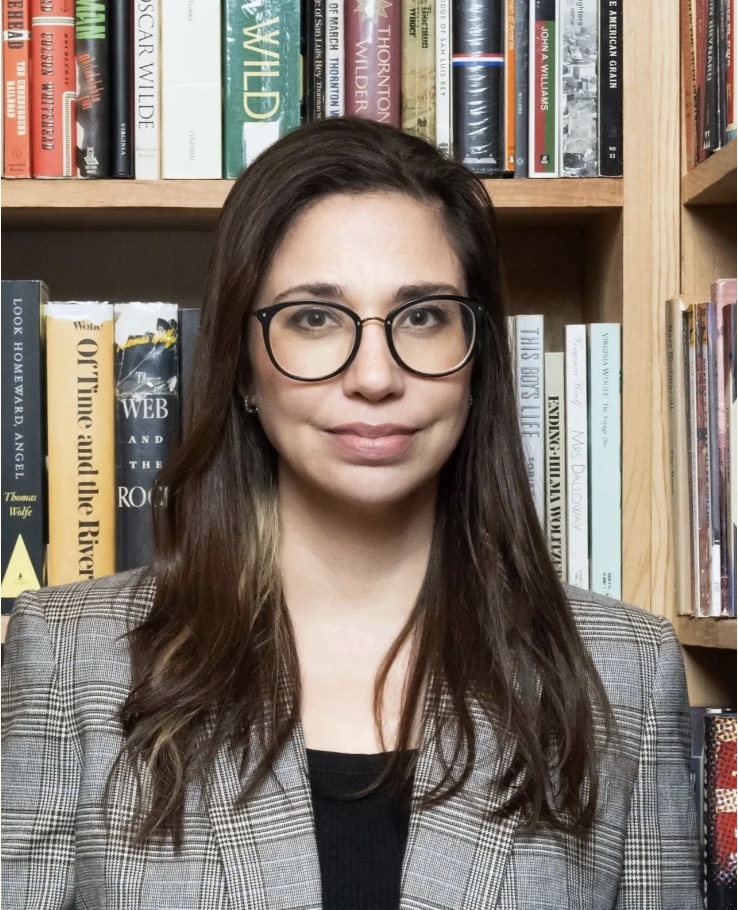
Photo credit: Beowulf Sheehan
I don’t enjoy the easier stuff to read, necessarily, the way that some people do. I wish that I did. I remember—my ex-husband really liked hiking, and I don’t like hiking. And I’d be like, “Let’s go on a rail trail; like, go on a nice flat hike.” And he’d be like, “That’s boring. No, this is not a real hike.” Sometimes, if I read something that seems kind of too—I don’t want to say “too easy,” but—is a little clunky, or a little too easy. It’s like, for me, a rail trail. Sometimes I wanna feel like I’m going up a mountain.
Jana M. Perkins: Is there a challenge for you at the level of the topic or the genre? Do you feel a need to maintain, like, “Okay: this is what I read for work; in my personal time, I don’t want to.” Or no?
Alia Hanna Habib: Mm-mm. I just read whatever I want. No, when I say that I wanna read something challenging, it’s not—I guess I’m trying to communicate without sounding snobby. I’m reading it because I enjoy it. If I’m reading something like this French thriller that isn’t really a thriller, it’s because on some level I’m enjoying trying to figure out what makes it tick. What is he doing here? Why is this thriller constructed this way? What’s he up to? But it’s not programmatic. I’m not thinking, “Oh, I have to read X, Y, Z because it’s in my category.” It’s always…