“I knew I would need to be my own safety net”:
Alissa Wilkinson on her career as a movie critic and author
July 2, 2026
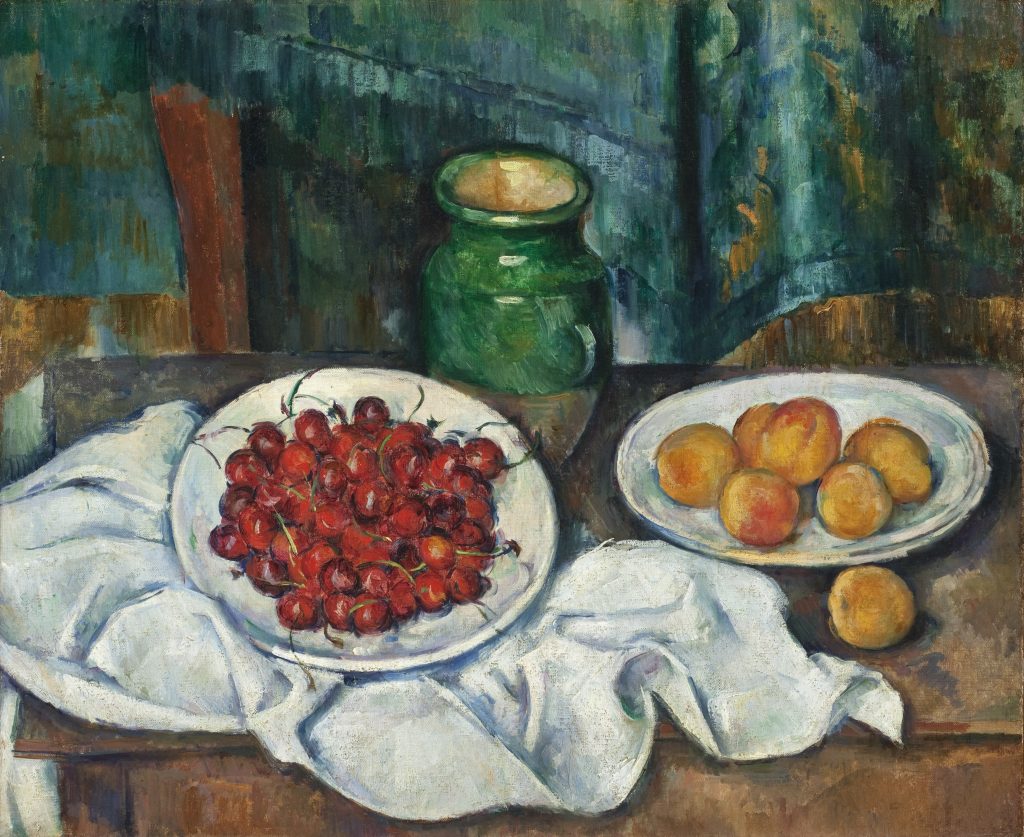
Paul Cézanne, “Still life with cherries and peaches” (c. 1886)

It’s often challenging, when writing about larger-than-life figures, to offer an unexplored take on their history due to the volumes upon volumes that have already been written about them. Yet with her latest book, Alissa has accomplished precisely that with her fresh perspective on the life and work of Joan Didion.
In We Tell Ourselves Stories, Alissa examines what she describes as the ‘American Dream machine’ of Hollywood’s mythmaking through her study of the iconic writer’s years in Los Angeles. It has been lauded as “thoughtful,” “propulsive,” “deftly researched,” and “prescient”—all terms that will be familiar to longtime readers of Alissa’s work.
I was delighted to be able to learn more about the history behind her own career through our exchange.
Jana M. Perkins, PhD
Host, Women of Letters
Alissa Wilkinson is a movie critic at the New York Times. She’s the author of We Tell Ourselves Stories: Joan Didion and the American Dream Machine (2025) and Salty: Lessons on Eating, Drinking and Living from Revolutionary Women (2022) and is working on her next book, due out in 2028.

How did your childhood shape your ideas about what work looked like and what was possible for you?
Alissa Wilkinson: Interestingly, I didn’t really know any writers or journalists when I was growing up, or not that I can remember.
My parents are smart people who place a high value on books and the arts, and who encouraged me to read, play musical instruments, and learn about art and history from a young age. But besides a couple of aunts, I think I am the first in my family to get a college degree. Being a writer, a professor, or certainly a critic was never something that entered my mind as something you might do as a job.
What I did learn was that it was important to plan to support yourself. I understood early on that if I wanted something, I had to figure out how to earn the money to get it. I knew I would need to be my own safety net—and that meant I have always thought about how to use my skills in many ways and be entrepreneurial about my career. That’s been exhausting sometimes; I’ve always had at least two sources of income, maybe more. But it’s also good, because often it means I’ve cast a wide net and connected with a lot of people in different fields, and I’ve learned a lot. In the end, I don’t think I’d be where I am today or do what I’m doing without having to hustle and do things for myself.
Fast-forward to today. How did the path to what you’re doing now unfold?
Alissa Wilkinson: It’s a long, winding, and pretty confusing story, but let me see if I can make it brief.
I majored in information technology and computer science back in the early aughts, when that was still a good idea (yikes), and my first job was as a business analyst in a huge investment bank. The work was fine, but I quickly learned I despised the 9-to-5 corporate life, and in a desperate attempt to feel alive I googled “how do you write for websites” and came up with, I think, an article on MediaBistro. That’s how I learned to pitch articles to editors, and I started pitching.
That was literally the start of my freelance career. I took a month-long continuing education class at NYU on film reviewing, because my boyfriend at the time (who I married) had gone to film school and I was curious about film criticism. I didn’t grow up watching movies really at all, but I was going to a lot of movies with him and was fascinated by the idea that you could “read” a movie like you “read” a book—that it was just a different vocabulary. That class turned into going to my first screening, and I pitched a review to Paste Magazine, which back then was still printed on paper. They took the pitch (I have no idea why), and that was my first published film review. (The movie was “A Guide to Recognizing Your Saints.”)
From there, I just kept pitching and publishing, and researching new publications to pitch, and coming up with new ideas and pitching them to new editors. Along the way I did a lot of other things to support myself. I quit my job at the bank to go to grad school (in the humanities) at NYU, but I knew I’d have to pay for it myself, so I got at job at NYU in the IT department so they’d cover tuition and I’d have income. And then things started to snowball: I worked in part-time and contract capacities for a whole host of non-profits and think tanks and institutes; I edited some journals and websites; I picked up a gig teaching freshman-level composition that turned into a full-time professor position at a small liberal arts college; and I kept freelancing steadily. Eventually I earned an MFA in a low-residency program, too.
In 2016, I got a call from the culture editor at the still-newish website Vox.com, asking if I might want a full-time staff writer job covering film and culture, which I certainly did. So for about seven years, I was a full-time college professor and a full-time staff writer at Vox. Then, to make a lengthy story very short, in 2023 the college closed, but the staff film critic job at the New York Times opened up, and after many months of interviews I was hired. And here we are.
Oh, and I wrote a couple of books on the weekends, too!
How do you get your work in each day? What does that process look like, and what are the conditions that help you perform at your best?
Alissa Wilkinson: I think the most important thing I learned in graduate school was how to write anywhere, under any conditions, and how to eradicate any semblance of precious-ness about my writing from my brain. Writing is my job, and I treat it that way. Sure, it’s nice when I feel inspired, and it’s great when I lose track of time. But I believe writer’s block is a luxury for people who have too much time on their hands. I know that I have to come up with a couple thousand words worth of thoughts every week or I won’t be able to pay rent, and what’s more, those thoughts are going to get printed in the New York Times. That is a powerful motivator!
In practical terms, I rarely write for my job before or after work hours, and I do write in the office. I write a couple reviews per week and often write notebooks as well. I see anywhere from 2-10 movies a week, sometimes more, sometimes less, depending on the season we’re in; I’ll see them in screening rooms most of the time, but occasionally in theatres with the general public and once in a while on screeners at home, though I try to avoid that. And while I try to go to screenings during work hours, it’s true that my work day usually extends into the evening. Part of being a good movie critic is always doing things that aren’t movies. So I go to the theatre a lot, I go to readings, I go to museums, and I try to engage with culture that isn’t movies—plus screenings often happen at night. So most weeknights, I’m out. (It helps that I don’t have children.)
As far as my other work: these days I usually only teach one course at a time, and it’s usually a graduate course, which means my work outside of the classroom is fairly minimal. (I was working all the time when I taught undergraduates!)
But I do have a finely-tuned system for book writing. I am a binge writer, meaning when I actually sit down to type words, I write thousands very quickly. But “writing” is not just typing words—it’s everything that comes before. So writing a book actually looks like this: I schedule one chapter to write per month. I block out a weekend at the end of the month to actually type everything out, which is sacred and uninterruptible. Then I figure out what research and thinking I have to do that month, and I schedule all that reading into my calendar and task manager, as if it is a syllabus and I am a student. I follow it religiously, and I type out the notes that I underline and mark from the book, which is unwieldy but effective. And then, at the end of the month, I am usually ready to write. This worked well for my last two books. Hopefully it works for my next one!
How do you decide which opportunities to pursue and which to pass on?
Alissa Wilkinson: My answer to this has changed over time. For a long time—like maybe a decade or so—I took almost every opportunity that came my way. Paid or unpaid, small or large, pretty much no matter what it was I would do it if I could. I referred to this as my spaghetti-on-the-wall approach: I didn’t know what would stick, so I tried to do as much as I could, provided I wasn’t running myself into the ground.
This approach was a good idea for me, because there were lots of things I didn’t know I could do or liked doing or would be good at (like giving lectures or teaching, for instance, which has turned out to be a major part of my career). There were lots of people I wouldn’t have met otherwise and places I wouldn’t have gone.
In the last eight or nine years, I’ve changed my approach, mostly because there’s a place you hit in your career where you stop seeking out opportunities and the opportunities come to you. I realized that I needed to say yes to things that sounded fun or interesting to me, and no to things that I knew I’d dread doing or regret saying yes to. There are exceptions: some things will bring in needed income, or will connect me to someone or something I need to be connected to. I also try to say yes when friends ask for a favour, or when I can help a younger colleague or student in a way that I wish someone had helped me when I was in their shoes. I can’t always do it, but I try to.
In general, I try to stop and ask myself how this decision feels in my chest: do I feel happiness about it? Then I go for it. Do I feel weary? Then even if it seems like a good thing, I probably will have to say no.
What’s a commonly shared piece of advice that you disagree with, and why?
Alissa Wilkinson: I think a lot of writers, especially people who are at the point of wanting to publish but aren’t quite getting where they want to go, feel like there is some kind of formula to follow to get it done. There really, really is not. I don’t really revise, for instance. When I get to the end of a draft, it’s basically done. Obviously I will revise after an editor takes a crack at it, but I am tweaking along the way. I used to think I was doing it “wrong,” but eventually I just realized that I can’t be doing it wrong, because … I am doing it.
Similarly, people will tell you that the key to writing a book is to get up early every morning and write 150 words a day, and that if you don’t do that then you aren’t really committed to writing. That’s hogwash. If I did that, the book would make no sense. I have to write a couple thousand words minimum at a time, or the interrupted flow feels nonsensical.
So maybe I am giving advice here instead: figure out what works for you, and then do not let anyone tell you that you’re doing it wrong, or that there’s a better way. If you’re writing, then you’re doing it right.
(This advice does not apply to editors trying to help you sound better. Listen to your editor.)
How has your definition of success evolved over time?
Alissa Wilkinson: I don’t know if I had a definition of success when I was younger; I wouldn’t have even known what to say. If I had thought I wanted to be a movie critic or an author, I probably would have said something very similar to what I do now, I suppose.
But I think these days, my definition of success is finding my work interesting, and having enough resources to spend time with friends, to help people, to travel and see things that I wouldn’t see otherwise, and to enjoy everything that is wonderful about living in this world.
Where can our readers find you?
Alissa Wilkinson: I’m always at the New York Times, and I’m on all the social media platforms (but mostly Bluesky and Instagram) at @alissawilkinson.