“I had to figure out how to get through”:
Victoria Redel on her career as a novelist, poet, and professor
March 26, 2026
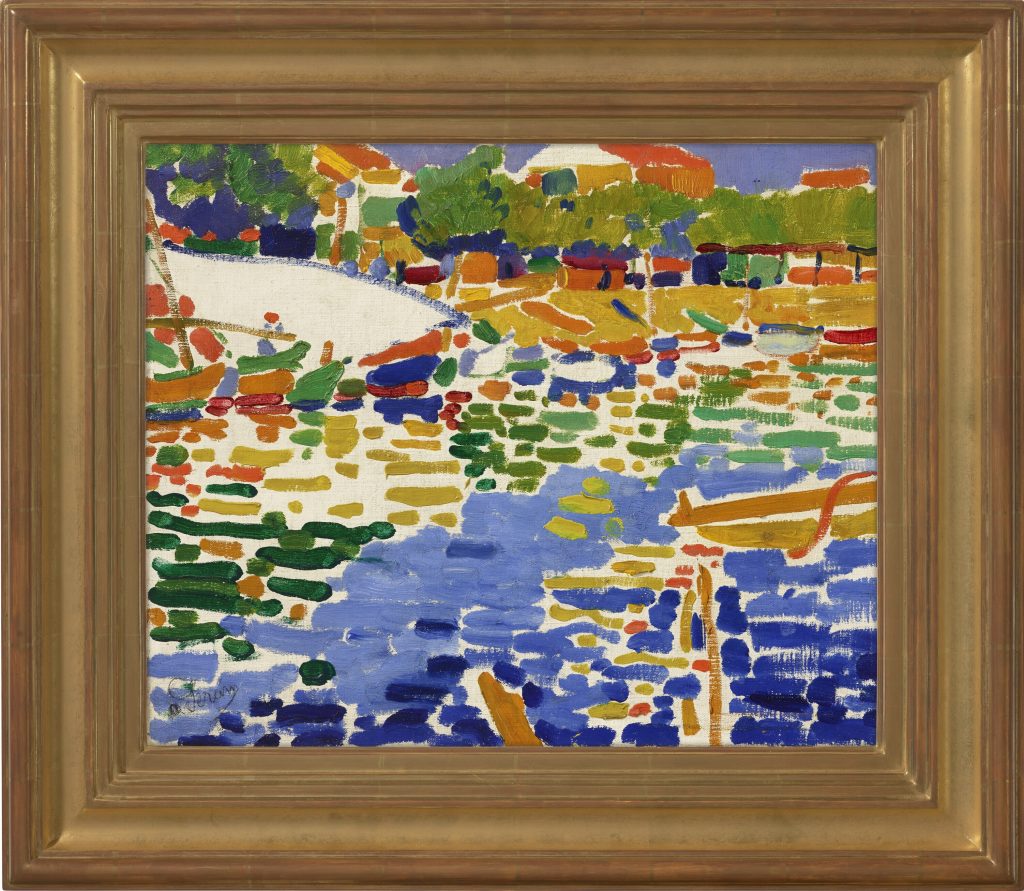
André Derain, “Barques amarrées à l’Estaque” (c. 1905)
You can listen to this interview on Apple Podcasts and Spotify.
Victoria’s latest novel is the rare book that is so wide-ranging and lushly articulated that it eludes description.
To simply say, for example, that it’s a work of historical fiction about two women painters in 17th-century Amsterdam would be to fail to capture so much of what it also is: an ode to women excelling, against all odds, in their chosen professions; a meditation on who has power and how it’s wielded; a decades-long love story; and a nuanced study on the complexities of mentorship.
And yet, for Victoria, it’s only the latest in the string of successful works that have marked her prolific writing career. I was delighted to have a chance to sit down with her and talk all about it.
Jana M. Perkins, PhD
Founder and host, Women of Letters
P.S. I am so excited to be able to gift two copies of Victoria’s latest amazing book, I Am You. Head over to our Substack to enter to receive your copy. 📚
Victoria Redel is a first-generation American author of four books of poetry and six books of fiction, most recently the poetry collection Paradise and the novel I Am You, published in October 2025 by Zando Project/SJP Lit. Victoria’s work has been widely anthologized, awarded, and translated into many languages. Her novel Loverboy (2001) was adapted for feature film directed by Kevin Bacon. She’s received fellowships from the Guggenheim Foundation, The National Endowment for the Arts, and The Fine Arts Work Center. Victoria has taught at Columbia University, the New School, Vermont College of Fine Arts, and was the McGee Distinguished Professor at Davidson College. She is a tenured faculty in the graduate and undergraduate creative writing programs at Sarah Lawrence College and lives in New York City and Utah.

How did your childhood shape your ideas about what work looked like and what was possible for you?
Victoria Redel: That’s an interesting and probably a great question to always begin with. I admire it.
I’m the youngest daughter of immigrant parents. Both my parents arrived at some point during the Second World War: my dad as a political refugee, my mom not as a refugee, although she came from France at a very late date. Both my parents are Jewish, but the background is broad. My father’s side of the family—he was born in Belgium to parents who were born in Poland. On my mother’s side of the family, she was born in Romania, though her father was Egyptian-born from Alexandria, and her mother was born across the river from Romania in what’s now Ukraine.
I say all that to say that our household was very much a first-generation household to parents who were very, very eager for their daughters to assimilate. So while each of my parents spoke at least six languages, and languages were spoken in our home all the time, my mother and grandmother spoke to each other pretty exclusively in Russian. I don’t speak Russian, although I grew up in the kitchen with Russian. I think I understood it as a kid, but I was never expected to speak it. My father and mother spoke to each other in French, because that was their secret language until we all began to study French and learn French, and then they began to speak to us in French a bit, or at least criticize our French, and they switched over to German. [There was] that tension—which I don’t think is an unusual one for immigrant kids in the States, from whatever their background is—where the family wants you to assimilate, but then, as you assimilate, that assimilation was a bit like a betrayal.
My mother began to study ballet in France as a young girl, came to the United States, continued studying ballet, and began a life as a professional dancer. When she married my dad at a young age and they had kids, she left a career as a dancer and became a ballet teacher. And, throughout my life, I grew up in my mother’s ballet studio. All three of us, that was our after school lesson.
One of my sisters became a professional dancer, and one of my sisters early on rebelled and said, “I’m out of this.” I just kept on. You pretty quickly, at a certain age, learn whether or not you have the stuff of a ballet dancer, as opposed to the great pleasure and enjoyment and even some of the skill. I didn’t have the feet of a ballet dancer, I didn’t really quite have the proportions of a ballet dancer, but I loved it. And I continued studying ballet until I was in my twenties. Not as a primary thing at all, but as a part of my life. The discipline of dance, the discipline of that—of what it was to have something that was very important, and that has a very strict kind of patterning and discipline, and yet is about expression and lyricism within a very constrained form—I think was really a monumental piece of my upbringing.
I grew up in the suburbs, and it wasn’t like my mom was the only woman I knew who held a job, but there were not that many mothers that I knew that worked, nor were there that many families that I knew where we had our grandmother who lived with us. We had an extended household, which is again outside of the sort of typical American experience. My dad was also a super hard worker. So that’s the first piece of it.
There were two more things I wanted to say about childhood and work. One is sort of less about my family’s upbringing and more about myself, which is that early in adolescence, at 13, I was diagnosed with scoliosis, as was my middle sister who became a professional dancer. I was put in what was then called the Milwaukee brace. The Milwaukee brace went from there [points to chin], in the front, down to the pelvis, and held you entirely erect. So I went from complete immobility, for 22 or 23 hours a day, except for the hour and a half where I’d be in a ballet class, which is all about utter mobility. And I don’t know what that meant to me at the time, but I think it was important.

Fast-forward to today. How did the path to what you’re doing now unfold?
Victoria Redel: I love that question, because that’s a question that students ask all the time. And my path was not direct.
Well, I mean, we could say on one level it was. I was writing poems from an early age, but a lot of people write poems, and I was studying art in college. When I graduated from university, I moved to Western Massachusetts, where my best friend was living and had a house. I could rent there for $65 a month, and I got a job in a local hospital working in a halfway house for recovering alcoholic women. It was substance abuse women, but at that period of time the primary diagnosis would usually be alcoholism instead of drug use.
I had no credentials for the job. That they hired this 21-year-old to be a counsellor in that halfway house is wild. But I had that job, with the idea that it was my job, and that the rest of my time I was going to write as a poet and try to make art, try to make prints. At that point, I imagined I was like Blake: I was going to write poems and be a printmaker. I worked for three years, first in that women’s halfway house, and then in another hospital in Concord, Massachusetts, where I worked as an outpatient clinician, by then having gotten Massachusetts state certification as an alcoholism counsellor. So that’s kind of what I thought I would do—I’d have these jobs, maybe I’d become a social worker and be a poet.
And then I decided to go to school as a painter and immediately got there and realized I’d made a terrible mistake. I wasn’t good enough. I just knew that I wasn’t good enough, and I’d never feel that I had been good enough, and that maybe there was some interesting things I could do as a painter, but they wouldn’t be based in sort of some of the essential things that I thought were core to be a great artist. I’d made a mistake, and I should have gone to graduate school in poetry. So I quickly left the painting program, just worked in the hospital, and applied to Columbia and went to graduate school in poetry.
So the line then began, right? Now I’m in my 20s. And then I worked in a high school; I taught high school for a while as a way to make my way as a writer, and then I derailed it all by having kids and pretty quickly realized, “Oh, this is going to be complicated: to have a full-time job, be a writer.” I had begun sort of also trying to write fiction, which—why was I adding a new thing in the mix? But I was, and having a child I quickly saw that my writing life was the one thing that I didn’t technically have to show up for. You know, a job you have to show up for, your kids you kind of have to show up for, and I had to figure out how to show up for my writing life. So I stopped being a high school teacher, and I figured out another job for myself, a kind of job on my own as a private tutor. I did that for a long time and then made my way to teaching. When books came out, my kids were old enough so that the tutoring thing didn’t work, and I was sick of tutoring one-on-one. I wound up getting a job in universities, and that’s kind of what I’ve done ever since.
So it was a windy path, but it wasn’t like—I wasn’t a lawyer and then a poet and then a chef. I essentially had two other kinds of gigs: one was teaching, and one was this earlier thing of counselling. But if you had asked me, when I went to graduate school as a poet, “Would I be also writing fiction?” That just would never have occurred to me. I mean, I loved fiction, but it never occurred to me that I would be writing it.
Jana M. Perkins: I’m really fascinated by this, because you seem to have always had this very vocational sense, almost, where you had the day job to support the writing, and then the writing separate from that. Which is the advice I would give to anybody today, and that I wish I had taken earlier, but really not the path that many seem to take. I’m curious where that impetus came from for you.
Victoria Redel: Well, I was always going to have a job, right? I got out of college, I was 21, and I’ve had a job ever since. I’ve never not had a job. If we return to the beginning parts, the family part—my father worked and my mother worked. Unfortunately, my mom made it seem kind of easy. My mom passed away when I was pretty young, when I was in my early 20s, so I would have loved to be able to ask her as I grew up, like, “How did you make this all seem so easy? To have a school, have a ballet company, raise three daughters, have a home and a life, a marriage, and make it all seem like it was just happening?” But I think that understanding that there was always going to be a job, and that the job, as important as it was—I mean, I really do, I love my life as a teacher. I’ve loved my life as a teacher, and to call it a gig is a kind of ridiculous thing to call a life teaching writing and teaching literature. But I did: I have always seen it as a means to give myself my time as a writer, however serious I am about it as it’s unfolding, and I am consummately serious about it.
I would often say to a student, “You’re almost better off being, like, a stone mason than a teacher. Because then you have a physical life, your head’s not getting filled with other people’s language. You’re working in stone, you’re working with your body. That’s a good thing. You still have your thought-mind to your own self.” On the other hand, teaching has made me think about how a poem is made, how a novel is made. And that conversation between myself and my students is one that’s infinitely rewarding for me in terms of my own development.
Did you have any mentors along the way?
Victoria Redel: A million mentors. Not a million, but yes: I’ve had really wonderful mentors. I mean—boy, I wish my mom was alive to hear me say that she was really my first mentor, because what I saw in her was what I just said: was some way in which you can be an artist and a parent, which was important for me, and one of the things that I was always going to navigate.
Also, in that world of dance, one of the things that I kind of bowed to in our earlier part of the conversation is the idea that it gave me a real understanding of discipline, of what you do to develop something. That you’re not going to just step out into the middle of the floor and do the lilac variation; that you’re going to spend endless hours at a barre doing tendus and relevés and échappés and jetés before you’re learning the sequence of steps of any particular variation. That sense of practice, that sense of discipline, that sense of showing up was something that I followed from her as the first mentor.
Then there have been great mentors to me along my way, teachers of mine. I’ve had the great good fortune of having remarkable teachers, whether it was by the example of their own work—you know, when I was in graduate school, Joseph Brodsky was my professor, Derek Walcott was my professor, I had the great good fortune of studying and having Stanley Kunitz as a mentor. The list went on. C.K. Williams was a teacher of mine. Poets that were so important to me, I had the opportunity to sit in rooms and hear them think about, and ask me to think about, in that case, what made a poem, and what inside of myself needed to be called upon for a poem to be composed, for a poem to issue through me as cleanly, as clearly, as truly as I could.
When I graduated college, I had a small town I moved to. The poet Adrienne Rich lived in that town, and she was the poet who at that point in my life I most admired. So I had to figure out how to get through the doorway. I needed to meet her. I had to figure out how to meet her. The first thing I did was I left my grandmother’s banana bread on her front doorstep—kind of a pathetic gesture—with a note saying, “Hi, I’m 21-years-old and a young poet, and I live up the street, and I just want to give you this as a token of my huge admiration.”
And then I wrote to her. Her and her partner—the great Michelle Cliff, who was a wonderful writer in her own right—were editing a magazine called Sinister Wisdom at the time, and I wrote them and said, “Can I be of use to you on this magazine? I live up the street.” So I got through the door. I don’t think she was—it wasn’t that she was a mentor to me on my poems so much as a mentor by example, and by the breadth of her intelligence and seriousness.
Jana M. Perkins: I wanted to ask you more about that, actually, about your time with Adrienne Rich, because in 2017 you also wrote a piece for the Literary Hub about how you’d worked as an assistant to her. And you write so beautifully about that experience in the piece, so I’d really encourage anyone who hasn’t read it yet to check it out, but I’m wondering: what has stayed with you about that time, as you look back on it now?
Victoria Redel: Well, one of the things that has stayed with me, and has stayed with me in general about the people who mentored me—whether it was Adrienne at that time, and Michelle, or also another poet. There’s another poet really not well celebrated enough in our country, the poet William Bronk, who I got to know because he judged a poetry contest at my college. I was one of the people whose poems he had selected, and then over time I visited with Bronk in his home and in the kind of larger community of poets that he had created where he lived, and we exchanged letters and I did send him poems. He was a very kind reader.
The key word that I would say about all of these people was their generosity. They were very generous at welcoming me in—not as their equal in any sense, but as someone that, because I took this art form seriously, they would take seriously, as well. Because I was curious and interested, they were rigorous with me. They weren’t just warm and fuzzy, at all, but they were rigorous and smart and had expectations that I be rigorous and smart. And that was great.
Adrienne and Michelle, when they’d take off to do things, I would go over and feed their cats and take care of certain things in the house, water plants. Just being in the house of someone—just, like, looking at their bookshelves, right? Sneaking in, and sitting at her desk in her chair—which I did—was an awesome thing. To be of use to them in some way was a great gift.
I’ll add one more thing. A couple of years later, I’d done a weekend workshop with the poet Denise Levertov. She taught at Tufts, and I was in Somerville, and my roommate at the time was a wonderful reader of poetry. Not a poet herself, but a great reader of poetry who’d gone to the workshop really just to hear Levertov for the weekend. We called up Denise and invited her to dinner, in that bold way that—you know, I was then… 22? 23? So we called up Denise, and we said, “We’d love to invite you over for dinner.” I mean, I wasn’t even her regular student at Tufts. I’d taken a weekend workshop with her. She said, “Oh, I’d love to come to dinner. Thank you so much for the invitation.”
Then, a couple of days later, she calls us back and she says, “Victoria, I have a problem because a friend is visiting me from out of town, so I think I should change the date.” And I don’t know why, I said, “Well, would you like to invite your friend to join us?” I mean, what a goofball, right? Instead of saying, “Of course; we’ll make it another time, Miss Levertov,” I said, “Would you like to invite your friend?” And without a beat, she said, “Sure, that would be fantastic.” And then she said, “Perhaps you’ve heard of my friend.” And I said, “Who would that be?” And she said, “Alice Walker.”
Jana M. Perkins: No!
Victoria Redel: Seriously. And it was—I can’t remember what year her novel had come out, but it was like the year before. So it was all Alice Walker all the time at that point. And I said, “Well, that would be terrific.” I mean, I think at that point I said, “Are you sure you want to come to dinner?” And she said, “Oh, yeah: it’d be great.” I get off the phone, and I say to Mary, “You’re just not going to believe this.” And she says, “What?” I said, “Denise is coming to dinner with Alice Walker.”
We didn’t know what to do. We were beside ourselves. We got out The Vegetarian Epicure, which was our fanciest cookbook at the time. We made spanakopita, because that was the fanciest dish we could think of, and a salad. We went out—we didn’t know a thing about wine and tried to buy whatever our version of the fanciest one we could find would be. And, indeed, Denise and Alice showed up for dinner in our third floor walkup, in Mrs. Morelli’s house in Somerville. And they hung out. And they had seconds. I have no idea what we talked about, but we laughed a lot. I remember that: that we laughed a lot, that we talked.
And now—I mean, at the time, I think I was just in awe. Now, I have a different kind of reverence for the moment, because it has reminded me, as I’ve gotten older and as I’ve taught people, that that’s part of the community of literature; that that’s part of the larger world I entered as an artist. That while I may be an elder now—I mean, we can think of how old Keats was when he wrote his poems. He was a kid. He was a young man. So there isn’t an age on a poem, right? There isn’t an age on what makes a poet. And so to remember that, and to think that you may be mentoring someone, but you’re also just in conversation with an artist, has been something. That when I have students in the room, I have artists in the room. Sometimes. Not all of them, but sometimes. I think that having been mentored well allows me, or I hope it allows me, that kind of openness.
Jana M. Perkins: I am always struck by that—how much the greatest gift that a mentor, or someone even just in a senior position to you, how much the greatest gift is very often just presence and a sense of being taken seriously.
Victoria Redel: Mm-hmm. Yeah. Yeah. Because what a thing, right? What a thing it is to say, “Oh, I see you. I hear you. This is what you want. Okay; I wanted that, too. I want that, too.”
Every one of us sits down with some kind of trepidation, and hopefully with some humility, when they start to write, and everyone sort of has to pull from some deep resource within themselves. It’s a courageous act, I think. I mean, I don’t say that with, like, a patting myself on the shoulder like I’m a courageous warrior. But I think it is a courageous act to want to find that, to go to those places. And so to have a young person who wants to do that too, and is trying to do that—all you have to do is say, “I see you. Keep going. Keep going.” I think a lot of being a mentor is kind of like being a cheerleader. I mean, not with pom-poms quite, but with something else.
How do you get your work in each day? What does that process look like, and what are the conditions that help you perform at your best?
Victoria Redel: Well, right now I’m teaching also, so that’s probably not performing at the best in terms of my writing time. Although that’s how most of my writing life has been.
I’ve been teaching and trying to write, so it brings us back to the discipline question. In a way, I think I was lucky that I had kids when I did, and kind of had that, “Oh, no: what the heck do I do?” moment, because I quickly realized, “Oh, I have to figure this out.” For a long time, I think I had Monday, Wednesday, Friday, for maybe a three- and sometimes a four-hour block those three days as writing time. Work came on the alternate days, or in the afternoons of those days.
Then there were periods of time where I didn’t have that, where something would go kaflooey in that schedule. There was a chunk of time that I just woke up at five and made my cup of tea, came to the desk in the dark, and worked from five till seven, which is when I would wake the kids. A good deal can get done five days a week in those two hours. They’re beautiful hours, because no one needs you in those hours. It’s still close enough to sleep that you’re not in the brain of the day. You’re not in the brain of, “What do I have to do next?” You’re not thinking, “I should do laundry. I should make dinner. I should go grocery shopping. I should get online and get a snow suit or baseball pants for my kids.” You’re in the dark. I would be in the dark at a desk. For many years, that was how I worked, the 5-to-7 shift of writing.
I like to work at a desk. I know writers who write in bed or other cool things. The answer is I’ve always kind of structured it out. I’ve never left it—once I had kids, which happened by the time I was 29, I made a schedule. Sometimes that schedule would change weekly, but I would make my schedule. Sounds kind of boring, but it works.
Jana M. Perkins: No—I think, as you said, it’s remarkable how much you can accomplish day after day, just putting in that amount of time. It really adds up.
Victoria Redel: My other thing that I would say to myself—because everything conspires against the schedule, also. Let’s say you have that Monday, Wednesday, Friday, 8-till-12 to work. Oh, but you have to go to the dentist. The dentist says, “I have Wednesday at 9.” If I were going to teach, if 9 o’clock was when my class was, obviously what I would say to the dentist was, “I’m so sorry: I can’t make it at 9 o’clock. I’m at work.” But it takes a certain kind of belief in what one’s doing to say, “I’m so sorry: I can’t make it at 9 o’clock because I’m at work,” when what I know I was doing is sitting at the desk, trying to bang out a sentence or a paragraph, and maybe not liking that paragraph enough to even keep it.
One thing was learning to say, “I’m so sorry: I can’t make that time. Would there be another available time?” The other thing that I learned to do was, in that same circumstance, “I’m so sorry: I can’t make the 11 o’clock appointment. But what if I made an appointment at 11:30?” Knowing that, then, I could still work from 8 to 10:30 and get on the subway, or get where I needed to get to the appointment. So, in other words, less writing time, but not give it fully up. That was the other piece of it.
How do you decide which opportunities to pursue and which to pass on?
Victoria Redel: If opportunities are things that start to engage my interest and I think, “Oh, let me see what would happen if I go down on that path for a little while”—there are many opportunities that I take for a while, and I run into a dead end, or I just make a big old mess, or it fizzles out. I think, “Oh, the question I was asking as I started into that wasn’t quite right.”
I don’t think of that—I mean, sometimes in the moment, I think of it as, “Oh, gosh; that was a failure. That was a waste of my time.” But, ultimately, none of them have been. For one thing, it sometimes takes a long time to circle around. Let’s call it something that has some heat to make, and I don’t always know why it does. So I might circle around it for a while and try entry points that are incorrect, or that just don’t lead me to the right place. Sometimes it just takes a while.
It’s not like an opportunity is just a one-shot deal. I mean, I’m sure there are lots of opportunities that were a one-shot deal, and I either had them or I messed them up. But a lot of the core ones—I Am You, this book, I had the idea of wanting to write a book about paint and painting 20 years ago. I started reading about paint and painting and the paint trade and the history of paint and the history of colour 20 years ago. I couldn’t figure out the book, and I ditched it. It was a failure. I wrote 60 pages into this failure. And then, 20 years later, I came across something so incidental, that I was like, “Well, what is that?”
I wasn’t thinking about paint and painting. I wasn’t thinking about the novel, but I came across a mention of the artist Maria van Oosterwijck, and tagged onto that was, like, “Little is known about the painter Maria van Oosterwijck.” I was like, “Oh, yeah; another forgotten artist.” It’s what we were talking about in the beginning: “Oh, someone who wasn’t part of the conversation.” And so I thought, “Who is she?” Then, when I encountered her, I encountered Gerta Pieters, who had been their family’s servant—brought in as a family servant, became Maria’s paint preparer and then her assistant, and they lived together until some point at the end of their lives when they weren’t.
I’ve now given you about as much information as is known about the two of them. I mean, a little bit more is known, but not much. Which is interesting for a novel, right? I wouldn’t have been interested in a novel in which a lot was known about an actual person. Then, suddenly, I was like, “Oh, wait a sec: who’s Gerta?” And many questions occurred to me. She became interesting to me, and she’s the voice of the novel. There was the paint, and there it was: all that dead-end opportunity of learning about paint came rushing back.
Jana M. Perkins: Before we started talking, I was wondering about your novel—where did this interest in painting and in the world of paint come from? But then, as we started talking, you said, “Oh, you know, initially, I went to college for painting.” How rewarding that must have been, to have the full-circle moment of, “Yes, that didn’t work out in that way at the time. But then, 20 years later, here we are.”
Victoria Redel: Yep. Yep. Yep. Coming back to the idea of mentors, Grace Paley—the great short story writer and poet, Grace Paley—was someone I knew. Mostly because she lived in Vermont when I was living up in that area, and was involved in political things that I was also involved in at the time. She was never a mentor of mine in the sense that she was a reader of my work, but a mentor by example of how she lived her life.
I had the opportunity to interview Grace at some point. We were in her house, and it was just after a story had come out in New Yorker magazine that she’d written. I said, “So, will you tell me a little bit about how this story came about, Grace?” And she said, “Well, yeah—you see that folder over there, Victoria?” I said, “Yes.” She said, “That’s full of all of the things that are my flubs. Like, I start to write something, and I can’t get anywhere. Occasionally, I look through that folder.”
Grace is writing on a typewriter, so it’s the printed pages of the typewriter. One of the great things that students, that young writers, I don’t think, get is the benefit of the endless drafts you did on typewriters. Anyway. She said, “I’ll start to go through the file, and I started to read one of the stories. I started making little corrections and revisions and crossing stuff out and adding something in. Then I got to where it was kind of petering out, and I was like, ‘Oh, this is pretty good. I know what to do now.’”
So the story that had been in The New Yorker had been begun something like 15 years before. It was, again, a case of that, and that wasn’t even a case of coming at it in a different way. That’s a case that you sometimes come up to what you think is a dead end, and sometimes you just need time. So when I found it again, I was in this whole completely different world where I thought I had begun 20 years prior. I felt so glad. I was like, “Oh, this whole body of knowledge that I had hasn’t left me, and…”